
Workplace

Escape the Office Cube — Companies Provide Dynamic Workspace Solutions

Escape the Office Cube — Companies Provide Dynamic Workspace Solutions

Traditionally, a professional workspace community is designed to function as an extension of your employer’s brand, seamlessly integrating key attributes and defining characteristics of the company. From the location of your office to where you sit each day to what type of equipment is required, your effectiveness was directly tied to the physical components of your company’s office space. Before the digital revolution entirely changed the way we live and work, providing customized solutions for today’s mobile workforce, this centralized workspace also provided a productive hub for employees to collaborate and meet with partners and clients.

Via adobe.com >

Making Workplace Wellness Count

Making Workplace Wellness Count

Going to the gym is about to get a lot more expensive. That's because the share of companies offering wellness programs dropped 13 percent this year. These programs -- which often include subsidized gym memberships, free fitness trackers, and bonuses for losing weight -- keep employees healthy, thereby cutting medical and insurance expenses. At least that's the theory.

In practice, many companies aren't seeing a return on their wellness investments. So they're ditching the programs. That's a mistake. Employers can save themselves millions through wellness programs. They just need to find ways to boost workers' low participation rates.

Via ki.com >

VIDEO - Case Study: Soludos

VIDEO - Case Study: Soludos

Soludos, a New York-based fashion footwear brand, turned to Herman Miller to find out how its new office could not only meet the needs of its people, but also become a true expression of its brand. The company built out its new space with help from interior design consultants Homepolish, who brought in vintage pieces to complement new furnishings from Herman Miller.

COMMERCIAL INTERIOR DESIGN: HOW TO CAPTURE THE BEST LOOK FOR GREATER PRODUCTIVITY IN YOUR BUSINESS

COMMERCIAL INTERIOR DESIGN: HOW TO CAPTURE THE BEST LOOK FOR GREATER PRODUCTIVITY IN YOUR BUSINESS

Enclosed cubicles, or open spaces and circular tables? Bold colors and designs on the walls, or neutral tones? What is the best look that will bring greater productivity in a business? Be it a retail store, law office, or graphic design studio, these are important decisions for businesses of all sorts to consider. This is where commercial interior design comes into play.

Via tangraminteriors.com >

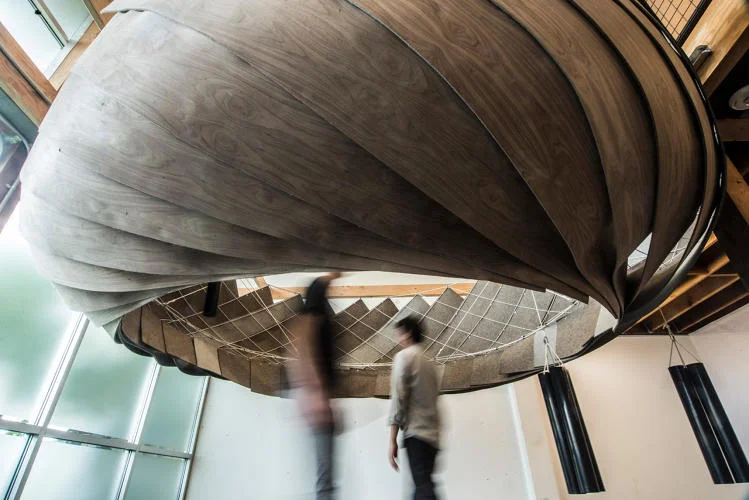
MIT And Google Give The Cubicle A Radical, Shape-Shifting Redesign

MIT And Google Give The Cubicle A Radical, Shape-Shifting Redesign

Once heralded as an ingenious design strategy for saving money and fostering collaboration, the open-plan office has fallen from grace. It's increasingly viewed by employees as a stressful, noisy nuisance, but with real estate prices soaring, it's not an easy trend for many companies to reverse. That's why some of the best solutions have been small-scale interventions that reconfigure existing open-plan spaces to fit employees' needs in the moment.

But ask Skylar Tibbits to design a reconfigurable space for your open office and you're going to get a whole different animal. That's what happened after Drew Wenzel, a civil and environmental engineer who is part of the campus development team at Google, met Tibbits and started collaborating with him earlier this year.

Via fastcodesign.com >

How Office Space Shapes Company Culture

How Office Space Shapes Company Culture

Day-to-day influences like your office space can affect how employees interact, what they do and if they have common interests and behaviors—all of which add up to company culture, Cushman & Wakefield tenant rep Kevin Meissner tells GlobeSt.com. We recently spoke exclusively with Meissner, who has written a thought piece on the subject, on how office space and culture work together to create a successful company.

Via globest.com >

7 Ways to Make Your Office Space More Productive

7 Ways to Make Your Office Space More Productive

Your employees spend a minimum of 8 hours at work in the office space every day. That’s a big chunk of time – about a third of their lives, to be fair. In those eight hours they must be exceptionally motivated in order to prove the best possible results.

One thing you can do to maintain motivation and productivity is spruce up the office space. People’s work environment can impact their productivity, so you should do everything you can to create a space that your employees will want to return to everyday.

Via everydaypowerblog.com >

6 tips for building a better workplace

6 tips for building a better workplace

The high demands on IT organizations translate into high demands on IT workers. With new technologies and processes, talent shortages, and studies showing that workers look for meaning, connection, and comfort in their careers, organizations are rethinking the way they design work. Office design is no longer based solely on the efficient use of space, but on creating an environment that fosters human creativity, productivity, and interaction. No more gray and white; no more clean and simple. In fact, no more cubicles and traditional offices. Instead, organizations are creating spaces that are, well, more humane.

Via hpe.com >

Healthy buildings becoming a key design priority for both architects and building owners

Healthy buildings becoming a key design priority for both architects and building owners

Almost three out of four of U.S. architects say the health impacts of buildings are influencing their design decisions, according to a survey by Dodge Data & Analytics in partnership with Delos and the Canada Green Building Council, and with assistance from the American Institute of Architects. 

Two-thirds of building owners surveyed also said that health considerations affect how they design and construct buildings. Sixty-nine percent of owners who measure employee satisfaction and engagement reported improvement in both attributes due to their healthier building investments. These findings are included in the report, “The Drive Toward Healthier Buildings 2016.”

Via bdcnetwork.com >

A Few Office Design Trends That Can Make Real Difference

A Few Office Design Trends That Can Make Real Difference

Office design trends are very important because their implementation can improve the aesthetic value of the office and boost productivity too. However, by following the wrong trends, business owners can make a huge mistake and witness counter effects. There are also situations when businesses are used to the old design, so when radical changes take place the old harmony is missing. So, the most important thing about office design trends and their implementation is to analyze them thoroughly before using them in specific places.

Via architecturelab.net >

What a 90 year old study teaches us about flexible working and productivity

What a 90 year old study teaches us about flexible working and productivity

Flexible working has developed a reputation as something of a silver bullet. It is the perceived solution to almost any of the major workplace problems you care to mention, including the gender pay gap, work life balance, churn, property costs, staff engagement, personal autonomy, stress, physical wellbeing, productivity and – of course – as a way of meeting the needs of those alien beings we now call Millennials. There is some truth in all of this, as we have known for some time. There is no question that there are major problems with the way many people work and that flexible working, hand in hand with new tech, is a way of solving them to one degree or another. And yet, as one of the most interesting yet overlooked recent pieces of research into the effects of flexible working has made clear, the reason behind this may be more complex and fragile than we might suppose and has an antecedence in research that is now approaching its centenary.

Via workplaceinsight.net >

Three Ways Organizations Can Design High-Performance Workplaces to Attract and Retain Talent

Three Ways Organizations Can Design High-Performance Workplaces to Attract and Retain Talent

The increasingly fierce war for talent is prompting more organizations to take into account the physical workplace to complement their talent attraction strategies. Three key areas organizations should consider when designing a high-performance workplace are a balance of “me” and “we” spaces, features and amenities that are inclusive of all employees, and connecting the workplace with its surroundings, according to a new report by CBRE.

“There are a variety of approaches to satisfy the high expectations of talented employees, while controlling or reducing real estate costs,” said Peter Andrew, Director, Workplace Strategy, CBRE Asia Pacific, “but the best approaches are people-centric strategies that embrace diversity, choice and community.”

Via cbre.com.hk >

PODCAST: 5 Strategies to Get the Privacy You Crave at Work

PODCAST: 5 Strategies to Get the Privacy You Crave at Work

You may have heard the open-office floor plan is dead. You may have heard we need more open spaces to collaborate at work. What if we told you, everybody is right? Let us explain.

Despite a growing need for teamwork, ideation and creativity to propel companies forward, we still need our privacy. Depending on your personality, what you’re doing and how your day is going, your need for privacy changes. Privacy is contextual. It’s all about what you need to do your best work in the moment.

PODCAST: Zuckerberg, Gates, Bezos: Why Privacy Matters

PODCAST: Zuckerberg, Gates, Bezos: Why Privacy Matters

Mark Zuckerberg, Bill Gates and Jeff Bezos are innovative business giants known around the globe. They all have at least one thing in common. They each find a way to control the immense demands on their time, making sure they give their brains the ability to think of the next big thing or solve their most pressing problem. It’s very valuable and requires the intentional search for privacy.

Will Outdoor Offices Be the Next Big Trend?

Will Outdoor Offices Be the Next Big Trend?

From the cubicle to open offices to coworking, offices are changing—and the outdoor office is one of the next frontiers.

Workforces, both in the US and globally, are in flux and today’s new realities unveil opportunities for creative solutions. Outdoor offices are one piece of the puzzle, and from Silver Spring, Md., to Amsterdam they are already impacting local markets and giving people a place to get away from the office and enjoy a beautiful day outside — all while working.

Via gethightower.com >

Transforming the office into a destination

Transforming the office into a destination

In the knowledge economy, where communication technology allows the workforce to be completely mobile, are corporate offices going extinct?

Some statistics would suggest the answer is yes. Many Canadians want to bid their offices goodbye. A 2014 Conference Board of Canada study found that more than 70 per cent of full-time workers aged 18 to 29 would be more satisfied in their jobs if they could work remotely using cloud software.

There is no question that technology provides full mobility for many workers, yet personal interaction remains a fundamental source of innovation in knowledge-based businesses, facilitates creativity and smoother workflow, and builds employees’ sense of identity vis-à-vis the firm.

Via reminetwork.com >

Millennials no different from their elders in attitudes to the workplace

Millennials no different from their elders in attitudes to the workplace

The portrait often drawn of Millennials is that of a generation which is keen to stand out from that of its elders, and which is difficult to pin down. They’re said to have difficulty accepting a hierarchical structure and no longer view their salary as the only motivating factor but instead are looking for a sense of accomplishment in their work. Yet as we reported recently, the behaviour and expectations of this younger generation has in fact stayed fairly constant. For them, the ideal company has attributes which are actually fairly similar to those cited by their more experienced colleagues. The result of the latest Edenred-Ipsos barometer into the under 30s suggests that for employers, the issue is not so much about dealing with this generation independently of the others, but rather globally rethinking leadership challenges in an environment which is increasingly digitalized, horizontal and multi-task oriented, taking into account individual countries’ cultural differences.

Via workplaceinsight.net >

How you can ride the wave of workplace change

How you can ride the wave of workplace change

For the average job-seeker or any parent wondering what kind of livelihood awaits the next generation, the current headlines are the stuff of anxiety attacks. In June, the Associated Press announced that it would begin using an automated writing service to cover more than 10,000 minor league baseball games each year. Driverless trucks may soon be taking over from humans, elbowing out an entire profession. New technology purports to bring great change to a surprising number of fields, including law, medicine and financial services. What will be the human toll and net effect on the economy? Has the U.S. reached an epoch of irreversible job loss?

Via weforum.org >

The state of the workplace in 2016? Everywhere and nowhere, baby

The state of the workplace in 2016? Everywhere and nowhere, baby

My trade is to ask questions about the workplace then make sense of the answers. That has been a particular challenge with the question, ‘what are offices today?’ What seems clear is that the various actors in the workplace ecosystem look at offices through very different eyes. Urban planning and development professionals still view offices as a distinct category of real estate and most real estate professionals view offices in terms of the delivery of floor space. Some things have changed,however. For some time, the hybrid economy of serviced offices has turned the product into a service. But, in many cases this has simply made the leasing of space simpler and more flexible. As Neil Usher says in his workessence blog, “while co-working is declared to be disrupting the institutional stuffed shirt that is the commercial rented sector, the sprouting centres come to increasingly resemble the corporate world at which their earlier incarnations cocked a snook”.

Via workplaceinsight.net >

Storytelling by Design

Storytelling by Design

A good story engages people, is relatable, and connects people to the content or the message. Storytelling is a key leadership tool in some of the most successful companies. For example, 3M has banned bullet points and replaced them with a process for writing strategic narratives, according to Dan Schawbel in Forbes MagazineP&G has hired Hollywood movie directors to teach senior executives how to lead with storytelling. While the verbal art of storytelling is no doubt a key to making presentations in the design world, a story can also be visually conveyed with graphics and the use of space through the design process.

Via interiorarchitects.com >