

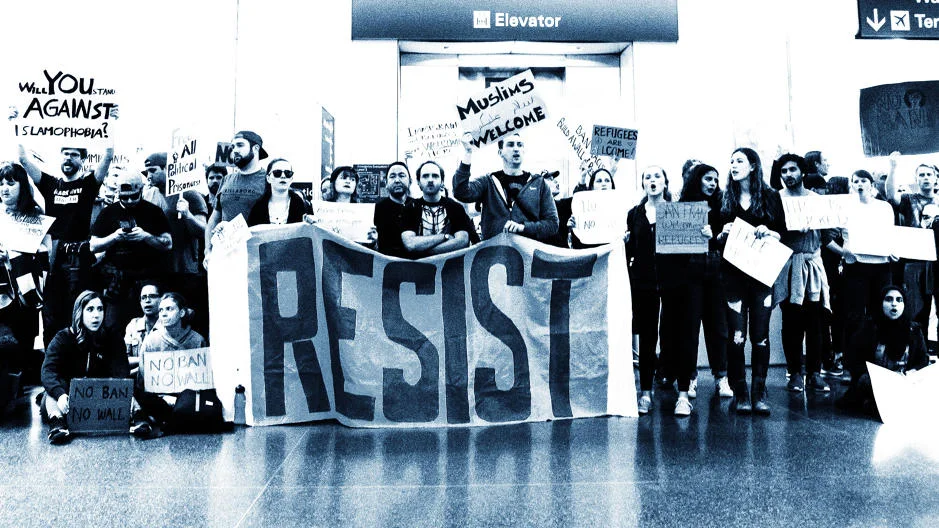
An immigration attorney helps explain what Trump's executive orders on immigration and visas mean for keeping and hiring employees.
Contract furnishings provider, Hightower received multiple awards at NeoCon 2021, including IIDA's 'Best Small Showroom' (under 4,000 sf) and 'Best of Competition' for its newly designed Chicago showroom.
Humanscale welcomes Elizabeth Margles to its Marketing Division in the role of Chief Marketing Officer. Margles comes to Humanscale with twenty years of experience in design, fashion and retail and a background in public relations and advertising.
The exclusive relationship with Kontrol's BioCloud® Technology will provide real-time detection of airborne pathogens such as SARS-CoV-2 to help make workplaces safer as organizations return to the office.
An immigration attorney helps explain what Trump's executive orders on immigration and visas mean for keeping and hiring employees.
Near the top of the wish list in almost every office design project these days is space for small-group collaboration. Business leaders know that creativity flourishes and ideas spark when people have access to the right environments for conversation and teamwork.
The traditional office—each person at a desk, meetings confined to conference rooms—is giving way to new styles that reflect contemporary ways of working. Today’s spaces are more inviting and flexible, less constrained and prescribed.
For years we’ve seen the technology industry and coworking entities shape the design of the workplace. Today, professional services firms — law, finance, tax, and accounting — are also transforming their workplaces and organizational cultures to operate more like their progressive counterparts. These traditional companies are finding value in adopting a transformative approach to office design. Law firms, in particular, are adapting the design of their spaces to adjust to new trends in the profession.
From the open office to the smart office, we’re seeing a lot of changes take hold as companies turn over on their leases. Firms are looking at everything from innovation centres to coworking and flexible spaces to create a workplace that meets the demands of their workforce.
But a diverse workforce isn’t the only factor driving a different approach to what the workplace means.
Recent studies have found that employee engagement, worker wellness, sick days, and overall happiness, are all highly influenced and affected by the physical workplace. These factors have also been linked to performance, as well as the ability to attract and retain employees.
It’s barely February, but analysts are already predicting a bumper crop of office construction in the U.S. this year. Researchers from Dodge Data & Analytics anticipate a 10 percent increase in office construction starts—and 10 million more square feet—over 2016. Meanwhile, the chief economist of ConstructConnect, Alex Carrick, pegs the increase at 11.3 percent. Whatever the number, experts agree that private office construction is poised for a boom compared to other types of commercial construction. But why?
The answer is twofold. For one, there’s a bump in the number of jobs—like accounting, architecture, and engineering—requiring office space for more workers. Secondly, companies are building additional urban offices near public transportation to attract millennials who’d rather live and work downtown. Pedestrian-friendly locations near nightlife and transit hubs are especially coveted.
A global study confirms that progressive organizations and their design partners are planning space to a new, wildly different set of benchmarks.
With all the changes to how, where, and why we work today, is it any wonder that organizations are exploring a variety of new design solutions to address the shifts?
To ascertain the substance and scale of these changes, we studied 120 progressive work environments from a variety of industries throughout the world. Although each of these offices was unique, they all shared traits that signaled significant movement in the way organizations and their design partners were planning space. In the course of our study, we found that the benchmarks that were once used to help guide workplace design have been turned on their heads.
New office designs are focused on ways to engage the employee by appealing to their senses and creating diverse workspaces. Increasingly, workers are seeking a better work environment and some would even settle for slightly less pay.
A happy employee is a loyal and productive employee. Is your office a great place to work? How about kick-starting the year with an office re-design that will maximize employee happiness and business performance?
Noise levels are one of the biggest sources of workplace complaints. As well as hampering productivity, prolonged exposure to even relatively low levels of office noise leads to elevated stress levels.
To tackle the growing levels of office noise complaints, we're looking at seven changes you can make to create a quieter office space for clients.
What’s to become of the traditional work office?
Is it possible that communications tools like Skype, Zoom.us and Google Hangouts will have the effect of making communal office spaces obsolete?
Is the day coming when organizations will redeploy workers to home offices – where they’ll have no commute, and the freedom to work all day in play clothes?
A few years ago, researchers at iconic furniture maker, Herman Miller, began a deep-dive into the future of the global workplace driven by the desire to answer questions like these. Clearly, technology already makes it possible for many people to work away from conventional offices. The question is whether that’s ultimately the best thing for workers, not to mention the companies that employ them.
It’s no surprise to say that technology is having a significant impact on the workplace and the use of corporate real estate. The fast pace of change has seen technology impact all aspects of business, government and culture, as well as personal life, with a constant flow of new innovations and solutions helping us to do things more quickly and efficiently. Equally, technology also provides a challenge to business and, more specifically, corporate operations, with a whole array of disruptive technologies. Disruption is indeed now running a swathe through a whole spectrum of industries. CoreNet Global’s recent report, The Bigger Picture: The Future of Corporate Real Estate, attempts to capture the impact of technological change, and a variety of other factors, that will influence, disrupt and transform the corporate real estate (CRE) profession. As business strategy and operations are reshaped and consumer preferences change, we will find that the ‘how’ and ‘where’ people want to work will transform.
Millennials care about health—even in their buildings. And this growing cohort of aspiring homeowners is fueling a new construction trend for “wellness” buildings, Construction Dive reports. “Wellness” buildings are not only energy-efficient and environmentally sustainable, but they’re also supposed to improve human health and quality of life. Everything from natural light to air and water quality to open office layouts can be considered a part of the movement to make buildings healthier for the people who live and work in them.
Offices lead the charge, where employers interested in attracting and keeping top talent will invest in wellness-related amenities like healthy snacks, nap pods, and better lighting. But experts say that health-conscious construction will soon bleed over into residential buildings as millennials get used to their healthy office perks and decide they want them at home, too.
This month, The Boston Consulting Group (BCG) opened its doors to its latest office in what’s been described as the new heart of New York; namely, the up-and-coming Hudson Yards development. Thought leaders from the world of workplace design including a representative from including Workplace Insight were invited to the launch of the new workspace to find out how the world’s leading advisor on business strategy has pushed the art and science of workplace design. BCG, which is consistently ranked near the top of Fortune’s annual Best Companies to Work For survey, worked with an array of experts for input into the design and use of innovative technologies, including Gensler, Humanyze and Cordless Group. Leesman was brought in to offer a neutral, objective voice when the project was already in motion to validate the design proposal.
The role of the corporate real estate (CRE) team is changing fast to meet new business requirements, driving those within the function to adopt new approaches to stay on top of what’s going on behind the scenes of the company.
Now, many CRE teams are borrowing a page from their sales colleagues’ playbook, and using customer relationship management (CRM) to improve alignment with their companies’ business units and demonstrate the value proposition of CRE.
Change in the property market is slow to respond to how many businesses now operate today, with flexible contracts and varied headcounts. Why? Well the property market assumes ‘quirky’ offices are a fashion statement relevant primarily to the tech industry and concentrated in a few hot spots like East London’s Tech City.
Advice on what to build to satisfy the rental market is dominated by traditional valuation based assessment by men in blue suits using formulas that are as much out of date as their choice of uniform.
Price per square foot returns has led to the architectural world producing office buildings that neither aspire or inspire; indeed aside from fancy external cladding on the odd crazy high rise, their role appears to be limited to conspiring with the construction industry to produce bland and predictably soulless buildings. The experience of working in such office buildings is not improved by funky reception furniture and free tea and coffee either. Comparing images recording the transitional stages of offices over the last 100 years raises the question: how much better is the experience today?
Here’s a question for the C-suite crowd: How do you think about change management as it relates to your company’s workspace? When you move, undertake a renovation, or pursue an FF&E upgrade, do you have a system in place to regularly communicate the reasons for the change, what it will entail, and how the new office will operate?
These days, we’re seeing increased focus on the engaged employee as a happy and productive one. Part of that engagement involves the physical environment and significant changes to it. When companies invest in their workspaces, it’s vital that employees are excited about the changes and comfortable with the new environment. That engagement is the best way to ensure a return on the investment.
We’ve all been there. You’re crashing on a last minute project at work and the person next to you is going on about their plans for the weekend, clearly not getting the hint that you’re in the thick of it. So what do you do? Pop in those ear buds and not so subtly say, “I’m busy!”
This scenario is becoming more and more common as offices transition to open floor plans and shared workspaces. While the majority of today’s workers welcome collaboration and open communication there will always be a place for focused, individual work. So, how do organizations accommodate these different needs? Start by identifying the different work styles within your office.
First, let’s define what constitutes a poor acoustic environment. According to this report, it could mean a couple different things. Number one: That the office contains unwanted noise or distractions such as the traffic outside or unsettling background sounds indoors, like phones ringing. And No. 2, there is too much quiet. To quote the review:
“By creating quiet you end up with a library, a place where you can hear a pin drop, when someone coughs it shatters the silence, if someone dare speak everyone is listening whether interested or not in the content of the conversation. You know the office is too quiet when people leave the office to make phone calls and this is a common occurrence.”
The solution, on the most basic level, to create an environment of audio comfort is to amplify some sounds (example: speech) while minimizing others (like background noise, traffic). Reaching audio comfort will supposedly increase productivity in the workplace.
In today’s connected world, the perfect workspace could be anywhere. Yes, the old adage says it’s all about location, location, location, but once you’re in a working environment, it’s all about design. These 5 design elements can determine, not only, the aesthetic and vibe of a workspace, but also influence employee productivity, engagement, and satisfaction.
Businesses should adopt teams of ‘workplace guardians’ to curate work spaces that support employee wellbeing and overall business performance, international support services and construction group Interserve has said.
The findings come as part of a new study from the company, Designing and delivering effective workplace experiences – a practical guide, which calls on businesses to shift their focus away from functional issues, such as cost per square metre, and towards the productivity boost that can be delivered through well-designed work spaces which engage employees and make them feel valued.
Interserve’s report sets out a six-stage programme for businesses to create effective workplace experiences which it says should be led by a team of experienced workplace coordinators or ‘guardians’ – a process that sees workplaces shaped by employees, for employees.
Outdoor work spaces are becoming more viable and legitimate since workers have greater mobility and can connect virtually anywhere via WiFi. Designing and creating an outdoor space as an extension to your indoor workplace enables employee choice in where one works. Unfortunately, according to the Environmental Protection Agency (EPA), the average American spends 93% of their life indoors – 87% in buildings and 6% in automobiles. Sounds like we need to get outside a bit more.