Workplace

3 Workplace Trends Millennials Are Eliminating in 2017

3 Workplace Trends Millennials Are Eliminating in 2017

The American workforce has never been more diverse, with generations spanning from Baby Boomers to Gen Xers and beyond. In recent years, however, Millennials (adults ages 19 to 35) have driven the biggest transformation in workplace dynamics. Experts and studies, for instance, tout how the Millennial generation is more collaborative than others and has a strong preference for remote work options. Additionally, Millennial workers are more connected and prefer to use technology to interact and get work done.

Why do these insights matter more now than ever before? According to an analysis from Pew Research Center, more than 30 percent of American workers today are Millennials. They recently surpassed Generation X in becoming the largest share of the American workforce. As more Baby Boomers retire, more and more Millennials will be stepping up to fill management roles.

With Millennials moving into leadership positions, and an even younger generation (Generation Z) preparing to enter the workforce, we predict there will be significant changes in office dynamics and operations starting in 2017, and lasting well into the coming years.

Via inc.com >

The Wearable Foreseeable Future of the Workplace

The Wearable Foreseeable Future of the Workplace

As augmented reality and virtual reality technology advance, AR and VR headsets are, or will soon be, entering the workplace.

Enterprises are scrambling to establish a competitive edge through the use of these glasses, goggles, and phone carriers, and pilots are rolling out globally in factories, construction sites, hospitals, and offices.

There are two major takeaways from these early pilots. First, employees critically value the comfort and wearability of headsets. If they’re too heavy, too hot, or an impediment to the user’s normal behavior, users simply will not use them. Second, user interaction with the headsets through head motion, hand gestures, and voice is inadequate.

So how about the eyes? Up until now, the only methods of interacting with information or controlling objects with your eyes was based on staring and waiting (dwelling) or winking or blinking to emulate a “mouse click.”

But a new interaction model has been developed — based on the biomechanics of the eye and the eye-brain connections — that enables virtually instantaneous interaction simply by looking.

Via innovationexecellence.com >

Is there gender bias in office design?

Is there gender bias in office design?

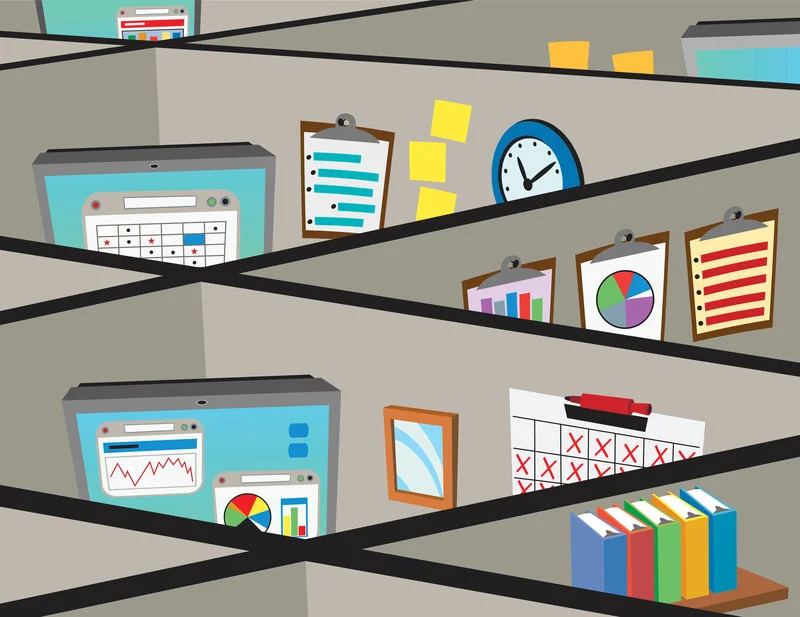
Your company’s office layout might be unfair to women, reports Fast Company. A "Women in the Workplace" study by LeanIn.org and McKinsey & Co. suggests that the squared off, segmented space that describes most office layouts favors the hierarchy working style men prefer. Women, by comparison, work best in open spaces, which they view as more congenial.

Via hrdive.com >

The secret to an agile workplace

The secret to an agile workplace

At its simplest, an agile workplace is one that successfully balances the people, places and processes of its organization. And when the balance is off, an agile workplace can adapt. It provides the room and resources that occupants need, or flexes to meet them when it doesn't.

The key to adaptability, of course, is knowing when the balance is off and having the insight to back your adjustments. Knowing how people use your space—through utilization studies and careful monitoring—is critical to innovation. It's the data that creative ideas spring from.

Via officerenew.com >

How to prepare for workplace changes brought on by millennials and Gen Z

How to prepare for workplace changes brought on by millennials and Gen Z

Just when we feel we finally have a handle on millennials’ workplace preferences and technology needs, a new predicament pops up.

They are becoming managers — and they aren’t prepared.

At the same time, the oldest of their successors, Generation Z, are beginning to enter the workforce.

Are we prepared to readjust all over again?

According to a recent Randstad global study, one of the top things that millennials feel their educations did not prepare them for is managing other people. Randstad’s Gen Z & Millennials Collide @ Work research also uncovered that this group finds corporate politics to be one of the biggest obstacles to effective working.

Those of us who manage a team know quite well that navigating the latter is a vital component to effective leadership, and this gap can certainly inhibit millennials’ success.

Via bizjournals.com >

What's More Distracting Than A Noisy Co-Worker? Turns Out, Not Much

What's More Distracting Than A Noisy Co-Worker? Turns Out, Not Much

Sounds, particularly those made by other humans, rank as the No. 1 distraction in the workplace. According to workplace design expert Alan Hedge at Cornell, 74 percent of workers say they face "many" instances of disturbances and distractions from noise.

"In general, if it's coming from another person, it's much more disturbing than when it's coming from a machine," he says, because, as social beings, humans are attuned to man-made sounds. He says overheard conversations, as well as high-pitched and intermittent noises, also draw attention away from tasks at hand.

The popularity of open offices has exacerbated the problem. The University of California's Center for the Built Environment has a study showing workers are happier when they are in enclosed offices and less likely to take sick days.

Via npr.org >

Companies relying more on “cool” offices in their recruiting efforts

Companies relying more on “cool” offices in their recruiting efforts

What makes an office cool? How about a rooftop deck that provides a stunning view of the city skyline? And what if that outdoor deck features floor-to-ceiling glass?

That’s the key amenity that helped bring Grand Rapids, Michigan-based law firm Miller Johnson Attorneys to the Arena Place mixed-use development in the heart of downtown Grand Rapids.

Miller Johnson Attorneys moved into the space in the summer of this year, leasing the building’s top four floors, a total of 60,000 square feet.

Scott Morgan, senior vice president with Colliers West Michigan, said that Miller Johnson has already hosted several receptions and events on the outdoor deck area. The deck, he says, is just one of the many features that attracted the law firm to this space.

Via rejournals.com >

Why Human Dynamics Are Key to Workspace Design

Why Human Dynamics Are Key to Workspace Design

The office watercooler days are long gone, and in its place are platforms like Slack, Toggle, and Facebook Messenger. With the rise of our increasingly mobile and connected relationships comes new ways of working. If we take a moment to look around us in any urban city, we’ll see the future of work all over: at our local coffee shop, brimming with entrepreneurs dialing clients, on the sidewalks, where teams are taking their walking status meeting, across open-office spaces, where employees roam freely. With these new standards for office culture, creating opportunities for professional relationships to develop and collaboration to occur is more integral than ever to an organization’s success.

According to a Google For Work Study released in 2016, 73% of employees think their organization would be more successful if they were able to work in a more flexible and collaborative way. As the needs and expectations of employees continue to evolve, companies are building and protecting spaces—virtually and in the office—to help colleagues connect, offer mentorship, and share expertise.

Via metropolismag.com >

Inside Deloitte’s Toronto Headquarters, Where Assigned Seating Is a Thing of the Past

 Inside Deloitte’s Toronto Headquarters, Where Assigned Seating Is a Thing of the Past

Personal desks haven’t disappeared entirely, but working at one day-in and day-out is on a dramatic decline. Like other major companies, Deloitte has gone all-in with the work-anywhere revolution. For years, the world’s largest accounting firm has been rethinking how offices of the future should look and function, and finding the best ways to keep employees happy and engaged.

Now they are transforming their vast global network of offices into fully realized open-concept hubs. The latest to open is in Toronto, housed in a newly constructed podium building designed by KPMB Architects and architects of record Adamson Associates and ERA Architects.

Via azuremagazine.com >

Green offices can ‘boost workplace productivity and cut costs’

Green offices can ‘boost workplace productivity and cut costs’

Businesses could massively increase productivity in the workplace by improving office design.

Air quality improvement, natural light and more spacious office buildings can have a significant impact on the health, well-being and productivity of its occupants, according to the World Green Building Council.

That can have a positive impact on a company’s bottom line by improving employee productivity and reducing absenteeism, staff turnover and medical costs.

For example, indoor air quality is improved when low volatile organic compound (VOC) materials are used in offices and the life cycle environmental impact of low VOC materials are lower than traditional materials. Increased daylighting reduces electrical loads, which helps reduce greenhouse gas emissions, the report states.

Via energylivenews.com >

WHAT BUZZFEED AND BLOOMBERG'S REAL ESTATE HEADS LOOK FOR IN OFFICES

WHAT BUZZFEED AND BLOOMBERG'S REAL ESTATE HEADS LOOK FOR IN OFFICES

As office space options have evolved, so have tenants’ expectations. Not only do tenants want a space they can easily access and can grow in, but a space that epitomizes their brand. 

This doesn’t just boil down to splashy paint, but everything from the electrical systems to the windows to the amenities needs to match a company’s perceived identity.

Finding and designing such spaces is BuzzFeed corporate real estate and facilities senior director Gabrielle Rubin Deveaux’s bread and butter. She didn’t find BuzzFeed’s current NYC digs, but she was tasked with designing and building it and helping the new media juggernaut move to it, all within 12 months.

That’s a lot to accomplish, but Gabrielle—who will be a panelist at Bisnow's Big NYC Office Event next week—tells us she was able to get significant headway when she asked BuzzFeed CEO Jonah Peretti for three adjectives the space needed to embody.

Via bisnow.com >

The Genesis of ideation and the places we go to have our best ideas

The Genesis of ideation and the places we go to have our best ideas

Because collaboration, creativity and innovation are increasingly perceived as key objectives and differentiators of performance, the genesis and mechanisms behind ideation and creativity are an an integral part of both business and personal development. As a consequence, there is growing interest in the way the physical attributes of work settings may influence or even trigger creative behavior. The cliché of the shower as one of these favorite places comes to mind and yet experience does show that the idea of seeking a setting, a “zone” if you will, for a specific purpose is intuitively right. This needn’t be a retreat or cocoon, as is often assumed, but can also be a crowded, busy, noisy place, which might explain why so often the most animated work conversations move out of the office shop into the coffee shop. Equally, highlight events or special meetings tend to be held in a “venue’, often dressed for the occasion.

Via workplaceinsight.net >

Global case for healthy green building provided ‘for first time’

Global case for healthy green building provided ‘for first time’

A global business case for healthy green building design and management has been provided ‘for the first time’ in a new report from the World Green Building Council with examples of the benefits to employers, building owners, designers and developers. The new report Building the Business Case: Health, Wellbeing and Productivity in Green Offices highlights ‘the global momentum behind healthy and green office design and operation’ and showcases over 15 buildings from around the world.  The research provides further evidence in the ways that green offices keep staff healthy and happy, improves productivity and boosts business’ bottom line. Steps like improving air quality, increasing natural light and introducing greenery – those which typically have environmental benefits such as using less energy – may also have an impact on the bottom line by improving employee productivity and reducing absenteeism, staff turnover and medical costs, according to the report.

Via workplaceinsight.net >

No Laptop, No Phone, No Desk: UBS Reinvents the Work Space

No Laptop, No Phone, No Desk: UBS Reinvents the Work Space

A desk is like a home away from home for many in the working world.

Family photos, trinkets from a vacation, an extra pair of shoes or spare chopsticks are just some of the things routinely left lying around in what has become personal space.

But that comes at a price for companies, particularly in cities like London or New York, where the cost of real estate is at a premium, and at a time when workers are more mobile than ever.

In its newly opened building in central London, the Swiss banking giant UBS is looking to change the way employees view their relationship with their work spaces.

Many of its employees at 5 Broadgate in the City of London will no longer be tied to the same desk every day with a telephone and desktop computer. Instead, the company has deployed so-called thin desks throughout the building.

Phone handsets were replaced by personal headsets, and employees can log onto their virtual desktops on computers at any desk in the building or at home. There are no laptops to lug around, and their phone numbers follow them from desk to desk or to their mobile devices.

Via nytimes.com >

10 Workplace Trends You'll See In 2017

10 Workplace Trends You'll See In 2017

Every year I give my top 10 workplace trend predictions for the upcoming year. You can read my predictions from 201320142015 and 2016 if you missed them. These trends are based on hundreds of conversations with human resource executives and workers, a series of national and global online surveys and secondary research from more than 160 different primary and secondary research sources, including think tanks, consulting companies, non-profits, the government and trade associations.

Between 2016 and 2017, the job market will continue to improve causing both job seekers and employees to have more leverage, which will cause salaries to increase and employers to invest more job advertising, staffing firms and employee benefits. Depending on who becomes the next president of the United States, hiring may freeze, slow or continue its current trajectory. The demand for a more flexible work environment will continue and you will see an emergence of HR practitioners with new skills, including people analytics, Internet marketing, branding and knowledge on new technologies like virtual reality and wearables.

Via forbes.com >

Is a Coworking Space a Good Option for You?

Is a Coworking Space a Good Option for You?

Coworking is sweeping the globe. According to the Global Coworking Survey 2015-2016, coworking spaces have increased globally from 3 to 7,800 between 2005 and 2015. The projection for 2016 is approximately 16,000 spaces; 25,000 spaces by 2017; and 37,000 spaces by 2018.

Three main factors drive this explosive growth. First, the gap between the mindset of small businesses and freelancers and traditional landlords, who like long term leases and require guarantees and company accounts. Second, technology that enables flexible and remote working. And third, the new generations do not consider the corporate environment appealing.

Coworking has changed the way people work and relate. It is said that coworking spaces are the combination of the best of a corporate office – resources, equipment, and collaboration – with the benefits of working at home – convenience, flexibility, and autonomy. All this with an added sense of community in a flexible, fun, and relaxed space.

Via icon.asid.org >

Are Open Office Spaces Good or Bad?

Are Open Office Spaces Good or Bad?

For all the talk a few years ago about the benefits of open offices--they facilitate collaboration and communication and make everyone equal, for example--some people are now backtracking. It turns out not everyone is thrilled with open offices because of the noise, the distractions, and the germs. Open offices may not be all they were billed to be, but does that mean organizations should go back to the more traditional, closed offices?

There's no real answer to this question because the debate often focuses solely on the physical office space. But an office by itself is just architecture and a building. What really makes the difference is the people and the environment of the office. Open offices are thought to be more forward thinking, but just because a company switches to an open office doesn't automatically make it a modern, future-proof organization. Likewise, an organization working in a closed office space isn't automatically traditional and stodgy. An office is merely the bones of the company that must be supported with the right culture and environment.

Via inc.com >

5 Futuristic Offices That Set Tenants Up for Success

5 Futuristic Offices That Set Tenants Up for Success

When we think of the coolest or most futuristic office spaces, it’s easy to get caught up in the awesome perks associated with companies like Google. And yes, while it would be undeniably great to work somewhere with a massage parlor, heated pool, and gourmet cafeteria, it’s also important to think about the office innovations that actually help people work better.

Via gethightower.com >

Microsoft brings back the traveling salesman with new WeWork partnership

Microsoft brings back the traveling salesman with new WeWork partnership

WeWork has long been a place for small startups and solo entrepreneurs to grab a desk and get to work, all with the flexibility of month-to-month payment. But today has signed on a rather huge client in the form of Microsoft.

WeWork and Microsoft are starting the “City as a Campus” partnership, which gives 300 of MSFT’s global sales and marketing team total access to all of WeWork’s Manhattan locations, communities and services.

This is interesting considering that Microsoft has a New York office, out of which its sales team could work.

The idea here is that sales people, in particular, work and sell in a very mobile way, taking numerous client meetings across the city in a single day. Microsoft’s GM of Office Marketing Matt Donovan believes that this will increase productivity and efficiency in the Global sales and marketing team, letting them touch down in any of WeWork’s locations to get some work done in between meetings.

Via techcrunch.com >

Workplace design can help workers feel happier says new report by Haworth

Workplace design can help workers feel happier says new report by Haworth

Haworth white papers: the right office design can increase the happiness of employees, whereas ping-pong tables, slides and even pay rises can't, according to new research by Haworth.

The findings are contained in a new white paper launched by the office furniture giant at the Orgatec workplace design fair in Cologne last week.

"Our research shows that there are specific design elements you can use to help workers feel happier," said Michael O'Neill, Haworth's head of research. "That's what the data is saying."

The report is the latest in a series of white papers by US company Haworth exploring office design.

Via dezeen.com >