Workplace

A New Healthy Building Certification From The CDC Is Coming To Your Office

A New Healthy Building Certification From The CDC Is Coming To Your Office

A new tool that will help employers create healthier workplaces is getting off the ground.

Fitwel is a health and wellness standard for buildings developed by the CDC, the General Services Administration (the government agency that runs federal office buildings). After testing it in government facilities, it was released to the public a few months ago, with the help of a New York City nonprofit, the Center for Active Design. It’s aimed at helping employers evaluate all the design factors that go into creating a healthy workplace, from proximity to public transit, bike parking, indoor air quality, healthy food access, and stairwell design.

Via fascoexist.com >

OPEN VS PRIVATE OFFICE: IS THE PENDULUM OFF ITS AXIS?

OPEN VS PRIVATE OFFICE: IS THE PENDULUM OFF ITS AXIS?

This morning, 77 million Americans got up and went to work in an office. Increasingly, Americans log their 40-plus hours in spaces with an open concept design, unassigned seating, exposed ceilings and maybe a ping pong table. But are choices and creative office really solving a problem?

During the rise of the creative office in the late 2000s, the New York Times reinvigorated discussion of an important concept: decision fatigue. The concept states that having too many choices can have an adverse effect on one's ability to make good decisions.  

Gensler principal Paul Manno says creating good workplaces has always been about offering choice, but this push for collaboration and flexibility hasn't necessarily being thoughtful and has gone too far. Architects and designers can't fill a space with some lounge chairs and sofas and call it choice; they must get smarter, Paul says.

Via bisnow.com >

RIDING THE WAVE OF THE CONTINGENT WORKFORCE

RIDING THE WAVE OF THE CONTINGENT WORKFORCE

Design and innovation can transform the way we work. The Center for Workplace Innovation (CWI) at the Design Museum Foundation is a hub for thought leadership focused on this transformative power of design. It will be hosting the Workplace Innovation Summit, a one-day conference featuring the latest thinking in workplace design and impact. Design Impact Stories, a series to be published by CWI, will tell tales of creativity in problem solving through design.

One such story is the new headquarters for SAP Fieldglass in Chicago. In this article, NELSON‘s Gary Miciunas and Theresa Williams will take you behind the scenes to see how Fieldglass is integrating creative workplace design solutions in their new, not-so-corporate headquarters.

Via workdesign.com > [paywall]

How to Work Remotely Without Losing Motivation

How to Work Remotely Without Losing Motivation

Telecommuters might feel guilty or ungrateful admitting it, but let’s be honest: We often miss the office. Even the too-talkative, too-messy, or too-cutthroat colleagues you willed yourself to ignore when they sat near you can seem endearing when you’re toiling away to the ticktock of your kitchen clock.

I’ve been telecommuting for almost 15 years. Sometimes it’s been across oceans and time zones (we are a military family), and sometimes it’s been across town (the office was short on space; I was a slave to my children’s schedules; the whole operation was virtual). At this point in my career as a freelance writer-editor and consultant, I’ve worked for multinational corporations, international development banks, associations, and nonprofits. I’ve identified one constant across this long-distance livelihood: No matter how satisfying the to-do list — or how much of an introvert you think you are — telecommuting leaves you craving company.

Via hbr.org >

Five Ways to Hack Your Workspace for Productivity

Five Ways to Hack Your Workspace for Productivity

Few things affect our productivity as much as what we surround ourselves with. Yet most of us rarely take the time to step back and really analyze our working environment.

Instead, we take a ‘set it and forget it’ approach to where we work.

We go to the same office, the same coffee shop, the same co-working space and try to force ourselves into a productive flow.

Because we spend so much of our lives working, why not try to make the place we work the best it possibly can be?

Whether you’re at home, in a shared space, or hanging out a coffee shop there are quick and easy fixes to help make your work space work for you.

Via observer.com >

Culture by Design

Culture by Design

Companies are built on products and services, but sustained by culture. Culture establishes the context and values for how people communicate, engage and work together and with their customers. This has always been true, but the significance of culture is increasingly being recognized as a critical differentiator that gives organizations a sustainable, strategic advantage. 

Via studiotk.com >

Open Offices Are Losing Some of Their Opennes

Open Offices Are Losing Some of Their Opennes

Noisy, open-floor plans have become a staple of office life. But after years of employee complaints, companies are trying to quiet the backlash.

Many studies show how open-plan office spaces can have negative effects on employees and productivity. As a result, companies are adding soundproof rooms, creating quiet zones and rearranging floor plans to appeal to employees eager to escape disruptions at their desk.

Companies are “not providing sufficient variety in spaces,” says David Lehrer, a researcher at the Center for the Built Environment at the University of California, Berkeley. Mr. Lehrer studies the impact of office designs on employees, and lack of “speech privacy” is currently a significant problem, he says. Employees in open-plan offices are less likely to be satisfied with their offices than employees in a traditional office layout, Mr. Lehrer adds.

Via wsj.com >

Hear No Evil, See No Evil: Acoustical Solutions That Are Easy on the Eyes

Hear No Evil, See No Evil: Acoustical Solutions That Are Easy on the Eyes

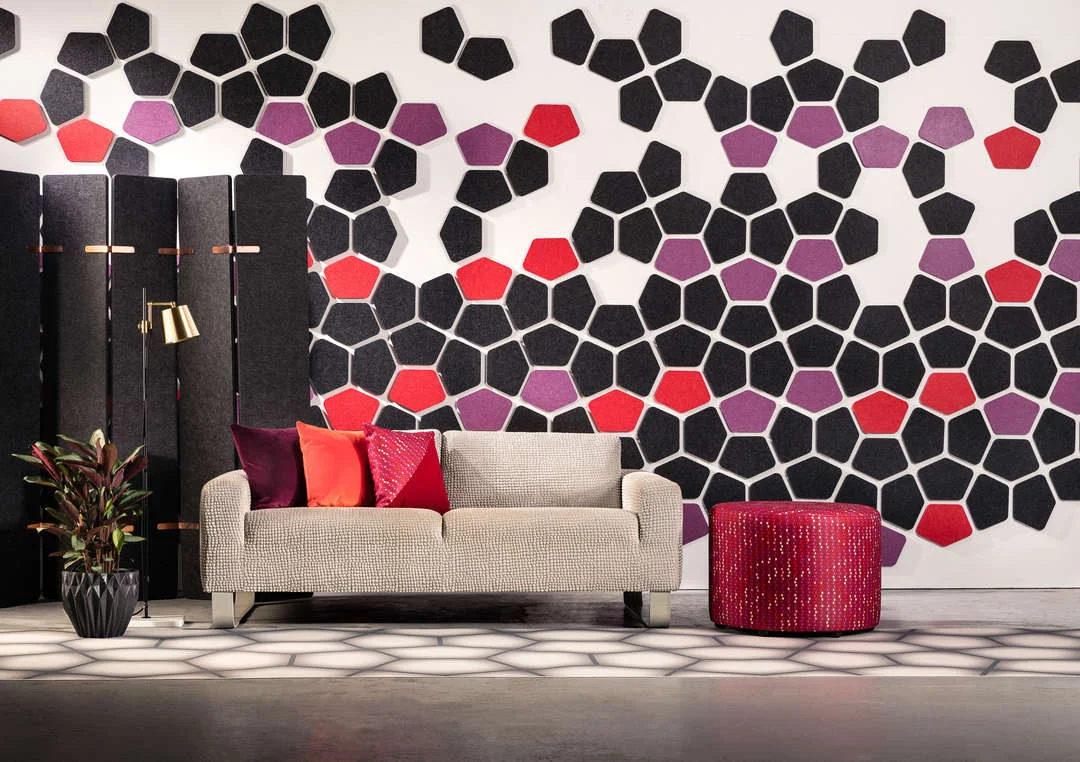
Open-plan workplaces continue to get a lot of flak for excessive noise and lack of privacy, but often go unchanged because, well, they’re already designed and built. Fortunately, acoustical-product specialists are helping to improve audio privacy and control noise in such spaces without requiring a gut renovation — and their solutions are attractive, to boot. One brand from this market segment that’s caught our eye is Kirei, who offers everything from peel-and-stick modular tiles and ceiling baffles to hanging screens and custom panels for furniture application. 

The company’s EchoPanel Tiles come in three different style groups depending on aesthetic and ease-of-installation needs. What we like best from this family is the Geometry collection, a peel-and-stick series comprising hexagons, squares, triangles, rectangles and pentagrams. The tiles can be arranged in any kind of configuration, and since they come in a total of 20 colors, they can even be used to create an artistic mural. Geometry tiles offer an NRC rating of approximately .36 and have a Class C fire rating.

Via architizer.com >

Feeling Good, Working Well

Feeling Good, Working Well

In the relocation of its Toronto corporate office, Meridian Credit Union’s transition team worked closely with designers Bullock + Wood and Interface to craft new offices that emphasize and support the well-being of its employees.

As Ontario’s largest credit union, Meridian knows well what it takes to help its members grow. And in the process of supporting more than a quarter of a million people enriching their lives and their businesses from Windsor to Ottawa, the community-centric credit union has also grown and now employs more than 1,500 people in several branches and various commercial and corporate offices throughout the region. So when the employees who worked at its Toronto-based corporate office began to outgrow their space in a building in the downtown core several years ago, Meridian applied the same business ethos it relies on to support its Members as the driving force behind the design of a new office environment that would reinforce the well-being of its employees and help them to function effectively.

Via interface.com >

13 Changes to Your Work Space That Could Improve Your Productivity (And Your Life)

13 Changes to Your Work Space That Could Improve Your Productivity (And Your Life)

There’s no doubt that architects spend a lot of time in front of a desktop, be it virtual or three-dimensional. In fact, although this statistic is not exclusive to architects, the average time a person now spends sitting down per day is 7.7 hours; in the United States the average is an unbelievable 13 hours. Of course this includes time spent on the train, watching a movie on the sofa, or a whole range of other seated activities, but the vast proportion of this time is likely to be spent working by a desk or laptop.

How can you improve the quality of that time, so it’s both well spent and, ideally, minimized? To have a more efficient, productive—and most importantly, more pleasant—time at work, here are 13 ways to improve your physical and digital workspace.

Via archdaily.com >

In Cold Offices, It's All About Your Feet

In Cold Offices, It's All About Your Feet

When a tech company recently came to Stefano Schiavon at the University of California, Berkeley to test an air-conditioning system for its office, his mind went to flip-flops. The new system would blast cool air from the floor rather than the ceiling, and this being the Bay Area, and this being a tech company, Schiavon figured he couldn’t use the same old models researchers have been using since the 70s to study thermal comfort. (Yes, that is the name for the academic study of maintaining a building at just the right temperature.)

He needed to test people in flip-flops.

Feet, it turns out, are exquisitely sensitive to temperature. When you get cold, the blood vessels in your extremities are the first to constrict, which is your body’s way of preventing more heat loss. “You feel uncomfortable because your feet get numb or getting close to numb,” says Edward Arens, an architect at the University of Berkeley, who also studies thermal comfort. If building managers could heat or cool the feet alone, they could cut energy and costs. So at Berkeley, researchers are focusing on thermal comfort from the feet up.

Via theatlantic.com >

DELOS™ AND HOK PARTNER TO ACCELERATE HEALTH AND WELL-BEING IN THE BUILT ENVIRONMENT

DELOS™ AND HOK PARTNER TO ACCELERATE HEALTH AND WELL-BEING IN THE BUILT ENVIRONMENT

New York, New York - Delos™, a wellness real estate and technology firm, has announced a partnership with HOK, a global design, architecture and engineering firm, to accelerate the organization’s mission to integrate health and wellness into the built environment. The new partnership will leverage HOK’s worldwide network of designers and clients to further expand the global reach of the WELL Building Standard™ (WELL™).

As part of this partnership, HOK is undertaking a major initiative to educate and professionally accredit its design teams through the WELL Accredited Professional (WELL AP™) program, a credential signifying advanced knowledge of health and well-being in the built environment and specialization in WELL. HOK also will collaborate with the International WELL Building Institute™ (IWBI™) to provide research and insight from subject matter experts that will strengthen the foundation of WELL.

Cozy in Your Cubicle? An Office Design Alternative May Improve Efficiency

Cozy in Your Cubicle? An Office Design Alternative May Improve Efficiency

In 1993, Jay Chiat had an epiphany while skiing in Telluride, Colo. The adman who created Apple’s memorable “1984” TV commercial thought it was time to “think different” about his own office: Chiat believed the workplace had become as static as an elementary school, with people only leaving their desks for lunch and for trips to the bathroom. He wanted his office to be more like a university campus.

Via bloomberg.com >

Architects primed to meet owner demand for healthy buildings

Architects primed to meet owner demand for healthy buildings

Architects may underestimate the importance of healthy buildings to owners, but they are focusing on it in their own design work. According to the new report, “The Drive Toward Healthier Buildings 2016” by Dodge Data & Analytics, 74 percent of architects consider building impacts influential in their design decisions. Furthermore, they align with owners in their other influence factors: costs, aesthetics, and performance.

via new.aia.org >

Outdated Offices Being Converted Into Popular New Residences In Surprising Cities

Outdated Offices Being Converted Into Popular New Residences In Surprising Cities

The concept of converting older, obsolete office space into apartments and condos isn’t new. In fact, it’s been a popular way to revitalize large downtowns throughout the country—particularly along the East Coast, including Manhattan. However, what is new is that these conversions are now quickly expanding across other U.S. markets, such as the Midwest.

The CoStar Group released a 2015 report that found office-to-residential conversions are occurring in nearly half of the CBDs around the country, which could add about 11,500 new multifamily units to downtown inventories.

"Office conversions are a huge trend we're seeing in a lot of places you wouldn’t think of, including Kansas City, St. Louis, Milwaukee and Cleveland," said Aaron Jodka, former senior manager of market analytics at CoStar Portfolio Strategy, now Director of Research at Colliers.

Other cities actively tackling conversions include Cleveland, Dallas, Philadelphia, Baltimore, Cincinnati, Minneapolis/St. Paul and Richmond, Va.

Via gethightower.com >

SHAPING WORK: PLANNING WORKPLACES FOR GENERATION Z

SHAPING WORK: PLANNING WORKPLACES FOR GENERATION Z

The design of work environments has undergone major changes in the past decade as Baby Boomers have begun to retire and Gen X'ers and Gen Y'ers (Millennials) have begun to dominate the workforce. Boomers desire for hierarchy and private offices has given way to open offices and more collaborative workstyles.

Will this trend continue for the foreseeable future? Most likely yes, BUT . . . 

The next generation of workers is just beginning to enter the workforce and they will have a significant impact on design of work environments. Generation Z (generally those born after 1995) will create another shift in how we think about work. In approximately five years, they will comprise approximately 60 to 80 million people and 20 percent of the U.S. workforce.

Via hga.com >

DESIGNING THE MODERN WORKPLACE

DESIGNING THE MODERN WORKPLACE

The workforce is changing rapidly due to modern technologies, and employers are shaping workplace design to adjust to the increasingly blurred lines between work and home life.

From social spaces with café-style character  to residential-inspired settings, contemporary workplaces are beginning to integrate choice, social interaction and professional identity – three important considerations for today’s workers. In this month’s news aggregate, we explore these three key trends influencing modern workplace design. 

Via coalesse.com >

Workplaces Spill over to Public Spaces

Workplaces Spill over to Public Spaces

As the retail footprint in office buildings shrinks – the result of an ever-rising tide of online shopping – landlords are layering amenity after amenity into public spaces. That could mean coffee, a bar, televisions, breakout space, and retail areas that have become more showroom than store. “It’s more efficient to fulfill the sale digitally – people are buying into a brand, but not buying the brand in retail space,” they say.

Their practice’s focus is on how office buildings and their neighborhoods provide what was once common in the workplace. This new twist is a model that started on the residential level – in buildings with small apartments and larger, common living rooms for hosting parties. “It’s even larger now for commercial space – it’s a place to meet that doesn’t feel like a conference room – it feels like your living room,” they say.

Via architectsandartisans.com >

Apple agrees to lease half million sq. ft. office at Battersea Power Station

Apple agrees to lease half million sq. ft. office at Battersea Power Station

Apple has confirmed the rumours that began in the Spring of this year by announcing that it is to relocate its UK headquarters from its current base in the West End along with several other sites to the redeveloped Battersea Power Station. The site’s developers say that Apple will become the largest office tenant at the £9 billion Battersea Power Station mixed use development occupying approximately 500,000 sq. ft. across 6 floors of the central Boiler House inside the iconic building. Apple is expected to move into the Power Station in 2021 at which time the office will account for circa 40 percent of the total office space in the whole development. 1400 Apple employees from existing offices around London will relocate to one of London’s best known landmarks. Apple has added, that this is a great opportunity to have its entire team working and collaborating in one location while supporting the renovation of a neighbourhood rich with history.

Via workplaceinsight.net >

Magic, psychogeography and the limits of workplace design

Magic, psychogeography and the limits of workplace design

Derren Brown is clearly on to something. And if you’ve read his books you’ll know that what he’s on to is finding ways to tap into our fascination with how our thoughts and actions can be manipulated using some well-defined and researched techniques and principles. Add in some showmanship and what you have is something that is indistinguishable from magic. You can believe in the magical and mystical if you like, but Derren Brown is a creature of the Enlightenment and has no truck with any of that. He’s got psychology and science on his side. The magic is in our own heads. It’s not just Derren Brown who has used the findings of psychologists to find ways to control people. Many of our current beliefs and the very workings of our society are based on this sort of manipulation. You can also see its workings in the way we think we think we can use workplace design to influence the feelings and behaviour of others.

Via workplaceinsight.net >