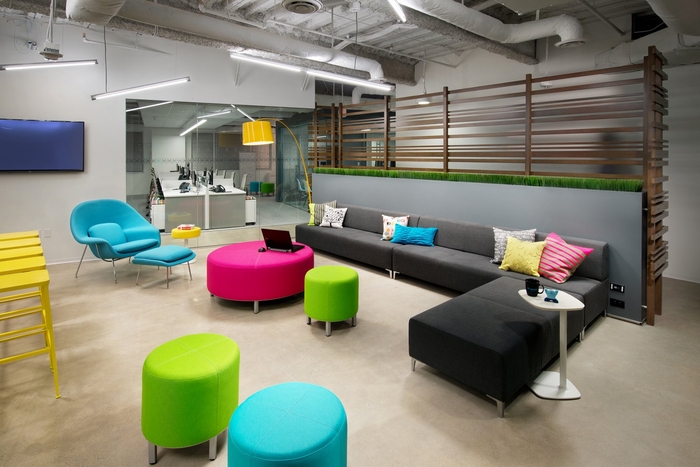
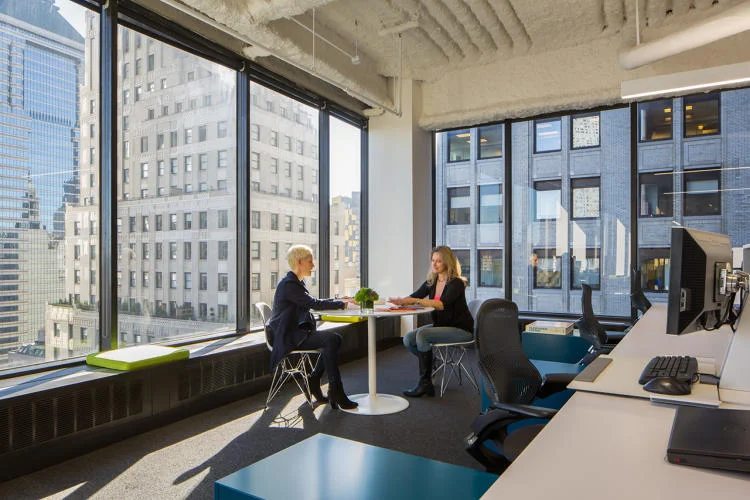
Instantly known worldwide as the seat of power in the US, Washington DC is also remarkable for its architectural splendour. This does not stop at the White House, the Capitol Building and other famous landmarks. The area is also a base for some of the biggest names in business, and so Washington DC offices, such as the following six, frequently rank among the world’s finest.
Knoll Participates in CoreNet Global ED Forum Workplace Well-being Panel
On August 18, Kylie Roth, Senior Director of Workplace Research at Knoll, presented “Well-being and the War for Talent,” during a panel session at the 2016 CoreNet Global ED Forum in Atlanta. Beginning with a history of the term itself, Roth discussed the growing importance of well-being and employee attraction and retention in the modern workplace alongside panelists Zoe Reich Margarites of Delos Solutions, Felicia Watts of Georgia Power, and Allyson Hajdu of Equifax. Although “wellness” originated in a rhetoric of physical health, she explained, today’s understanding of employee well-being is far more holistic, taking the mental and social aspects of work into account. The panelists continued the discussion by offering their own experiences as case studies for well-being initiatives.
5 ways startups have revolutionized office design
The sun is setting on the American cubicle.
Millennials have already overtaken baby boomers as the largest living generation in the U.S., and they're poised to dominate the workforce — according to a report by Jones Lang LaSalle, millennials will be the dominant demographic by 2020. And as Boomers retire, so too is the outmoded office design that came to define their generation's corporate work environments.
Since the emergence of the modern startup at the turn of the century, tech companies like AOL, Google and Facebook have led the charge in reimagining the rigid formalism of traditional offices in favor of more flexible, human-centered workspaces. As a result, traditional corporations are following suit with ambitious design aimed at fostering work-life balance, retaining the best talent, and inspiring greater productivity.
Only seven percent of workers say they’re most productive working in an office
Fewer interruptions from colleagues, fewer distractions make home the preferred place for maximum productivity, claims a new study from recruitment consultancy FlexJobs. The survey of more than 3,000 respondents interested in work flexibility claims that only 7 percent of workers say the office and traditional work hours form the best time and place for optimum productivity. More than half (51 percent) of people reported that their home is their preferred place to work. Eight percent said they would choose a coffee shop, coworking space, library, or other place besides the office and another eight percent would choose the office but only outside regular hours. 26 percent go to the office during regular hours to complete important work only because it’s not an option to go elsewhere. According to the survey, 65 percent of workers think they would be more productive telecommuting than working in a traditional workplace.
You Can Design A Happier Office Culture. Here's How
In the 1960s and '70s, the psychologist Mihaly Csikszentmihalyi gave pagers to study subjects, ranging from motorcycle gang members to sheepherders. When the pagers buzzed, the participants' job was to record their happiness levels. These studies ushered in the modern era of happiness research (and gave birth to an idea you’ve probably heard about—the times when productive hours float by like minutes in "flow").
Why Building Better Offices Is The Key To Employee Engagement
Research shows that educated millennial professionals are moving into more densely populated urban environments both for work opportunities and for quality of life. The energy of cities inherently drives innovation. A recent New York Times article describes a trend of large corporate campuses returning to cities to create a new style of workplace and attract younger talent. On a more distributed scale we see the burgeoning of shared work spaces led by WeWork. In both of these trends, the growth of the sharing economy is key. When people live and work in close proximity, it allows for the efficient sharing of cultural, leisure, social and professional amenities.
How wellness is shaping office design
We know that sitting in front of a computer screen all day doesn’t do our health any favours, but recent research published in The Lancet has again highlighted the true cost of a sedentary lifestyle: those who sit for eight hours a day have up to a 60 per cent higher risk of dying prematurely compared with those who exercise for an hour daily. For businesses, the cost of poor health is lower productivity, which is why the issue has found its way into the boardroom and subsequently into the workplace.
But telling employees to exercise at the start or end of their day isn’t a realistic solution. Nudging them in the right direction by providing workplace initiatives and a healthier environment is much more feasible. We’ve seen a rise in employers and landlords promoting wellness within the office itself. This goes far beyond subsidising gym memberships; very often it’s changing the very way the office is designed.
What Does The Future Of Work Mean To You?
Every time conversations about the future of work come up, the focus seems to always be drawn towards jobs and technological unemployment (or employment). Everyone is concerned with the job of the future and if in fact there will be jobs in the future. Naturally this is understandable.
Still, I feel "the future of work" is much broader in scope than just looking at jobs. Behaviors, management style, demographics, and globalization are all rising themes in the future of work, among many others. Communication and collaboration are also a huge area of focus. That being said, I want to know what you think about when you hear the phrase "future of work." What do this phrase actually mean to you? Does this conjure up robots and automation? Perhaps this makes think about workplace flexibility and autonomy? Use #AskTheFuturist on Twitter to share your thoughts. You can also use the hashtag to ask me a question for a future episode. I'm very curious to read your responses!
Fads in corporate architecture: Putting on the glitz
PICTURE a set of Lego that covers 50,000 square metres (540,000 square feet), costs over one billion Danish kroner ($150m), and has a mini-golf course on its roof. In reality the new global headquarters of the Lego Group will be of real bricks and concrete, but its boss, Jorgen Vig Knudstorp, describes it with childlike glee. It will rise up in Billund, in rural Denmark, he says, as “a great facility, not opulent, very playful, for children too.” “People house” will be a totem of the firm’s success.
Product: Round up of Acoustic Solutions
From baffles and upholstered room dividers to desk and lounge options that reduce noise pollution, new materials and styles eliminate office distractions in myriad creative ways.
Want to Strengthen Workplace Culture? Design a Ritual
Picture this: you’re an engineer at Facebook’s headquarters in Menlo Park. You’re sitting in a lecture with a guest speaker, learning about the latest and greatest in nanotechnology. Next to you, one of your friends is capturing the speaker’s best quotes on his phone. He texts a quote to a graphic designer friend who’s sitting across campus in Facebook’s internal print shop. The designer immediately designs a poster based on the quote, then pins them up around campus. As you walk out of the lecture, you see the posters—echoing the lecture that ended just seconds ago—already plastered on walls.
Mind blown, right? But this is just another day at Facebook. The rapid poster-printing phenomenon is coordinated through Facebook’s Analog Research Lab, an internal workshop open to everyone on campus. Employees can create any posters they want, on any topic they care about, and put them up anywhere—guerilla style.
9 Ways to Create a Workspace That Enhances Your Productivity
Whether you’re working from home or in an office, it’s important to feel comfortable at your workspace. Space can be tight and distractions may be plentiful, but a comfortable and inviting office increases productivity and efficiency in addition to boosting your moral.
Here are seven comfort tips to help make your office space more comfortable and transform your workplace into a better place to work, and enhance your productivity.
Execs find open-concept offices inspire: survey
The Creative Group recently conducted a survey of 400 American marketing and advertising executives and 1,000 workers, age 18 and over, on workplace creativity. Findings show that managers and employees disagree on the best office layout to encourage innovative ideas.
When executives were asked which type of office layout they believe is ideal to bolster creativity and innovation, 36 per cent chose an open-concept space for multiple people. However, 26 per cent of lower-level employees in the same field agree this layout can improve creativity.
How the office of the future will lure staff back from home
Today's workers are nomads. But tomorrow’s workers are less likely to be.
Two thirds of workers say that they work more productively in the office than anywhere else, according to a new survey we have conducted, and half say that working away from the office makes them feel stressed and disconnected from colleagues.
As businesses tackle the challenge of a disparate and disconnected workforce, what can we expect from the workplace designs of the future to tempt workers back to the office?
Could Sensor Networks Be The Secret To Less Hellish Offices?
Open offices aren't going anywhere soon. But an experimental sensor network and app from NBBJ might make them more tolerable.
The offenses of open offices are numerous and well-documented: noise, frigid air (and its cousin, blazing heat), and productivity- and creativity-killing distractions, to name a few. The reality of rising rents and limited space means that open-plan workspaces won't go away completely. But the architecture firm NBBJ has a solution to make them more tolerable: an experimental sensor network and smartphone app named Goldilocks that lets workers find space in their office that's not too hot, not too loud, and otherwise just right.
Is open-plan the collaboration magic bullet? Measuring the effects of office design on how organisations behave.
The need for more collaboration within organisations seems to have become something of a mantra. And the office design industry is busy trying to capitalise on that need, by offering new and exciting ‘flexible’, ‘open’ office layouts that will help to break down entrenched organisational barriers and enable greater knowledge sharing.
Here's how design and tech are making shared workspaces more productive
It can be a lonely road for the freelance worker. Lots of work is solitary by nature, but for freelancers who typically work from home or the local cafe, the isolation and lack of collegial interaction can be, well, unproductive.
"When you are your own boss ... you are responsible for everything that you do," Leo Newball, a freelance web developer, said in a phone interview. "I need a space where I can detach from waking up and just working in my bedroom. That wasn't working at all for me."
Want to Inspire Creativity? Give Employees Their Own Space
Company executives and their employees disagree on the type of office space that's best for sparking creativity, new research finds.
A study from the staffing firm The Creative Group revealed that employees prefer secluded spaces when trying to come up with new ideas, whereas company leaders believe open spaces are best for innovation.
Specifically, 36 percent of employees said a private office is most conducive to encouraging creativity, compared with just 18 percent of executives. Conversely, 36 percent of executives think open-concept work environments are best for on-the job innovation, compared with only 26 percent of employees.
In Depth: Why Shoe Companies Are In A Headquarters Building Frenzy
Office design has come a long way from the fluorescent-lit cubicle farms of the past. Thanks to mobile technology, changing work styles and the growing influence of millennials, today’s workplaces are now sleek, employee-focused enclaves decked out with lifestyle amenities such as rooftop decks, gyms, coffee bars and lush green spaces.
Companies now see their office facilities not as a cost burden, but as a powerful competitive advantage. According to experts, a well-designed work environment can boost employee productivity, drive creativity and innovation, and help companies attract and retain top talent.
EXPERTS WEIGH IN ON THE OFFICE OF TODAY
The office of today has evolved, with employees able to enjoy more options than ever before. CBRE president of Greater LA and OC Lewis Horne, who is among the all-star panelists, says today's office has evolved beyond simply desks that are used eight hours a day. Lew describes office space these days as a "strategic tool that can and should be used to attract and retain today’s top talent." As a result, office environments must be "forward-thinking spaces" with a focus on accommodating the creativity and well-being of workers, Lew says.