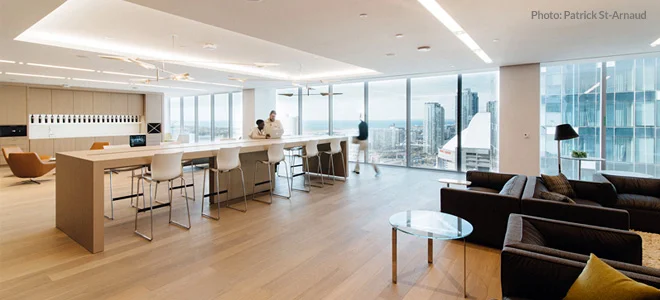

“It’s both and,” says Joseph White of the open-versus-closed debate that has dominated conversations about the workspace since, seemingly, time immemorial. (Though in actuality, it’s just been going on for a few years.) As Director of Workplace Strategy, Design, and Management at Herman Miller, he believes in the idea of purposeful variety, a practical concept developed over decades across the organization’s many disciplines—and formalized now as a key concept within what Herman Miller calls Living Office®. Purposeful variety runs across all variables—from furniture selection to color to organization to layout—and at its core is a deep and profound understanding of how people in the workplace operate, and what they need.
Reinforce Devotion Through Branding
The golden arches, a tiny fighting leprechaun, the swoosh … everyone can spot these iconic logos from a mile away, but what goes into that brand recognition? It certainly didn’t happen overnight and its success goes far beyond a logo. In order for organizational branding to be successful it must be purposeful and strategic. A winning brand creates advocates both internally and externally. Employees come to work every day understanding the company’s vision while customers experience first-hand that vision coming to life. This cohesiveness is achieved through corporate culture, ritualization, consistent messaging and a shared passion for the service being delivered.
WHAT WE LEARNED IN CHICAGO ABOUT DESIGNING FOR CHOICE IN THE WORKPLACE
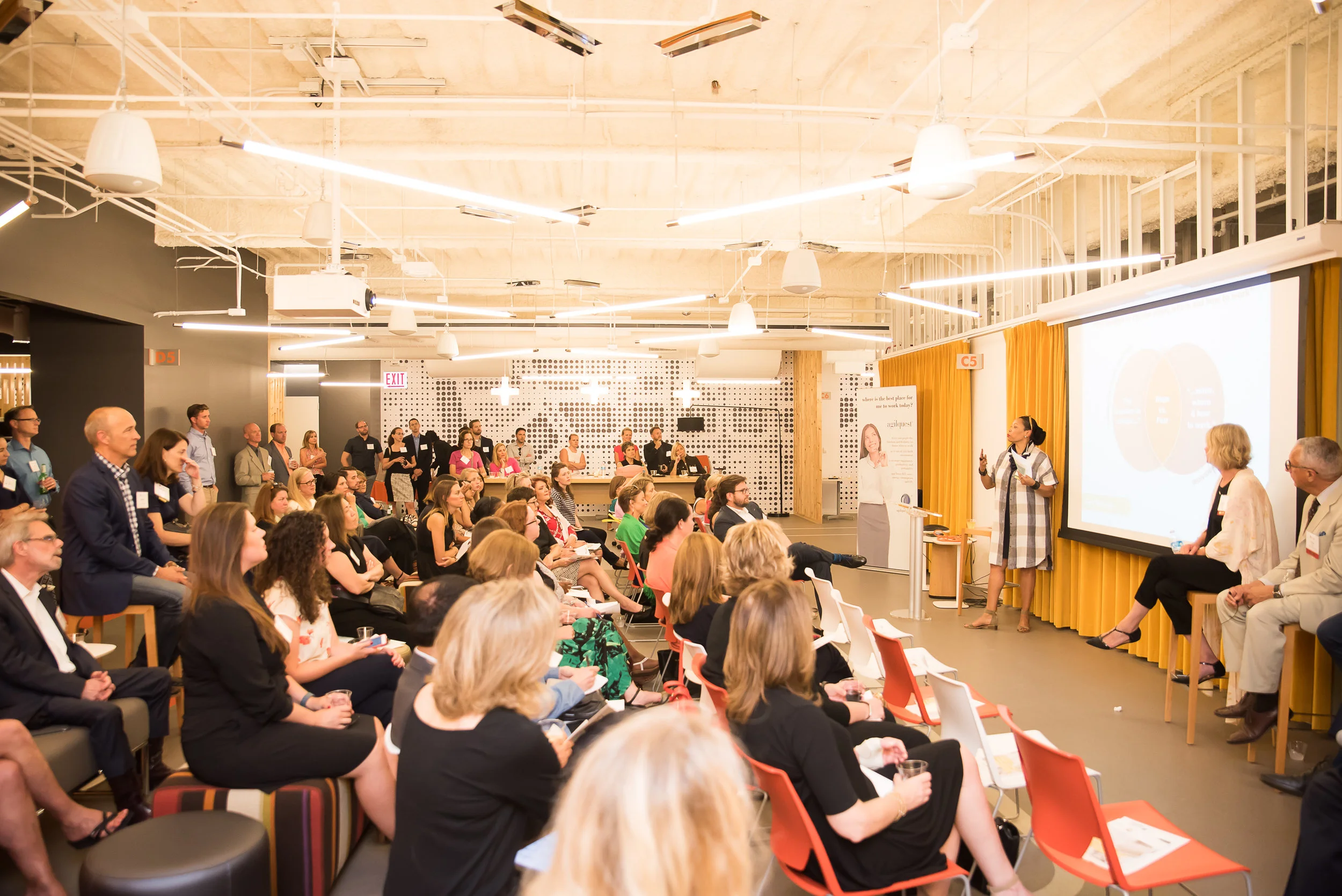
Just like our recent event in D.C., we brought our general “choice in the workplace” TALK to Chicago at the end of July, but with a twist: we didn’t just talk about choice. Instead, we stacked the panel with designers only, and talked about designing for it. Cheryl Durst, the executive vice president and CEO of IIDA, the International Interior Design Association, joined us again as guest moderator, and Discover hosted us in their cutting-edge, 26,000 square foot Discover 606 space, which the company makes available for employees who are working downtown or need a place to touch down between meetings.
We shouldn’t lose sight of the importance of form in our quest for function
The enduring struggle to improve the working conditions and performance of people through the design and management of workplaces carries more than a whiff of the Enlightenment, a period in which pure reason was seen by its proponenst as more than enough to convince the world of the ways in which we could improve the human condition. It’s a battle that was won in some ways but which continues to endure to this day, as you can tell from the very existence of the latter day evangelists of reason such as Richard Dawkins and Sam Harris. Yet one of the issues with arguments based on pure reason is that they leave gaps regarding abstract notions such as love and beauty. When it comes to workplace design the idea of beauty seems pretty important. Yet the very notion that an attractive workplace will make people happier and more productive seems to assume that we can agree on what is attractive in the first place.
Managers and staff in creative sector disagree on what makes a creative office
According to a survey by recruitment firm The Creative Group, managers and employees in US based ad agencies don’t see eye to eye on the essential characteristics of a creative office. When asked what the ideal work environment is for on-the-job innovation, the top response among advertising and marketing executives was an open plan workplace. Employees, however, seem to prefer more private, concentrated time, with a private office being the most popular option. According to the study of 1,400 US based ad agency managers, executives and employees, over a third of managers favour open plan environments compared to just a quarter of employees. Twice as many employees as managers would also rather have a private office. Around a fifth of both groups opt for a cubicle. Perhaps the most interesting finding of the report is that just 4 percent of both groups think the best option is remote working.
10 Proven Ways To Build The Workplace Of The Future
We’re entering a new era of work. It’s becoming increasingly apparent that for businesses to succeed, they need to do more to ensure people are at the centre of their focus. Creating a thriving company culture is key to attracting and maintaining top level talent, increasing efficiency and making work a great place to be.
Not only that, evidence now shows that treating your employees well can boost brand value. It takes more than just putting a ping pong table in the lunchroom and stocking up the beer fridge.
Research suggests that most millennials would even take a pay cut to find work that matches their values, puts their skills to good use in a positive environment.
A change manager becomes the change managed
Normally, Teknion works with clients who are undergoing change management. Recently, the contract furniture company underwent change management itself.
For its 20-member Canadian sales team, the opening of a new Toronto showroom, called the Collaboration Hub, meant relocating from a head office on the outskirts of the city to a downtown address in the emerging south core district.
Over a third of office workers complain about poor air quality
Almost 70 percent of office workers believe poor air quality in their place of work is having a negative effect on their day-to-day productivity and wellbeing, claims a survey commissioned by the Building Engineering Services Association (BESA); and a third of workers are concerned that poor air quality could be having a negative effect on their health. Opening windows is the most commonly used form of ventilation with 60 percent of workers saying it is the first thing they do if they need fresh air. However, although this is seen as a natural response, opening windows runs the risk of further polluting the working environment by letting in outdoor toxins, the survey claims. Given that we spend 90 percent of our time indoors and on average, 212 days a year at work, BESA has called on firms, managers and employees to ensure proper, effective, well maintained ventilation systems are operating in all offices across the UK.
Why the modern workplace is failing
While the ability to focus without interruptions is a top priority for employees, this need is being disrupted by today’s open plan offices.
The latest report from Oxford Economics, entitled When the Walls Come Down, surveyed over 1,200 senior executives and non-executive employees from businesses worldwide and found that modern workplace design was affecting overall productivity levels.
Noise and distractions presented challenges particularly in open plan offices, the report found.
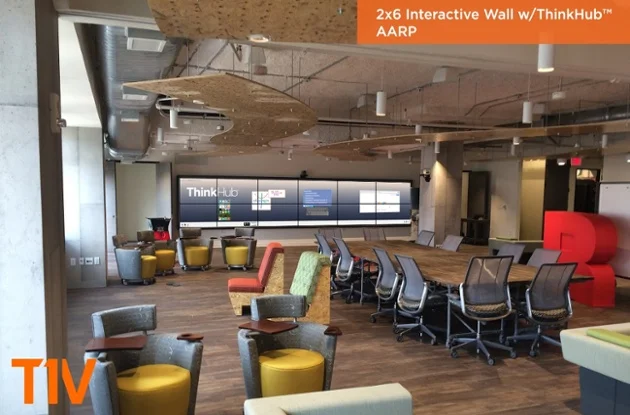
How to choose and deploy interactive technology in the workplace
We worked with Applied Global Technologies (AGT) to come up with 7 Tips for Deploying New Interactive Technologies in the Workplace. Here are some of our top tips for choosing the interactive solution that's right for you and your organization:
When workplace strategy builds bridges between people and place
The world of work is changing rapidly and profoundly in a way that we haven’t seen since the time of the industrial revolution. Yet even as we stand at a momentous, game-changing inflexion point, the 21st century workplace strategy sector is still dithering about whether to join in the revolution. They are like the industrial mill owners of 19th century England who adopted a ‘make do and mend’ approach to business and failed to invest in new technology only to be forced out of business by foreign competitors who had invested in radical new, state of the art technology.Today the technological game changer is digital technology rather than weaving technology, but the effect is the same. Unless the workplace strategy sector embraces change and builds bridges between the ‘people’ side of the business and the ‘place’ side with other workplace specialists, their industry will become as dead as a dodo.
Office Obsessions: Steven Glowczewski
A designer in IA Interior Architects' New York office opens up about the importance of infusing flexibility throughout the end user experience.
There's no such thing as flexible
Technology was meant to herald a new way of working anytime, anywhere – but that’s not the case, writes Georgina Kenyon.
We didn’t get the flying cars or the self-lacing shoes. But we did get the work world of the future – you know, the one where the internet allows us to work anytime, anywhere, resulting in the death of the 9-to-5 life.
5 WAYS OFFICE DESIGNERS CAN CREATE A MORE ACTIVE WORKPLACE
In an average work week, office workers spend five hours and forty-one minutes every day sitting at a desk. But research has shown that an extremely sedentary lifestyle is bad for our health – and that even if you’re hitting the gym after work every day, it’s still not enough to counteract the hours spent sitting down at the office.
So today I’m looking at 5 ways designers can create a more active workplace for their clients, in order to improve employee health and wellness, and lower healthcare costs incurred by an extremely sedentary lifestyle.
Duffer psychology applies in workplace
I like to golf but I am not very good at it. There is something about the game I just can’t seem to master, but I’m am not willing to spend the time to fix the problem. Yet when the opportunity arises, I play a round and get frustrated enough to say I am never going to play this stupid game again.
What Gensler's Workplace Survey Tells Us About the Future of the Office
From the cube farm to the open plan, the conversation around office design has long focused on extremes. But there's an advantage to finding middle ground, according to Gensler's U.S. Workplace Survey 2016, which polled more than 4,000 workers across 11 industries from companies that the firm has deemed to be leaders in their respective fields. The results relate the “quality and functional make-up of the workplace and the level of innovation employees ascribe to their organization,” according to the firm.
PSFK Labs examines the key steps for designing an adaptable work environment to energize employees
Change is an inevitable process that is part of any business that wants to grow, and 75% of CEOs say that an educated and adaptable workforce should be a priority for businesses according to the Global CEO Survey conducted by PwC in 2016. Forcing executive company-wide orders is not the best way to enact any sort of change. Instead, implementing a permanent culture of empowerment is the best way to ensure continuous, positive change.
Workplaces that foster inspiration, motivation and rewards create an environment of energized employees and thriving business. In our new Future of Work report, PSFK Labs explores the steps for developing and implementing this kind of culture.
In Defense of the Open Office: The Case for the Hybrid Workplace
The once-trendy open office has taken quite a beating in the last few years. Huge, undivided rooms. Long tables lined up with laptops.
Not a wall in sight. Once the darling of agencies, startups, and big companies trying to be cool, the layout is now “destroying the workplace,” a “trap,” or quite simply, “dead.”
These articles and the hundreds like them cite multiple studies showing that contrary to their intent, open offices hinder productivity, produce a sense of emotional isolation, and basically get in the way of anybody getting anything done.
The Changing Shape Of The Modern Workplace
Whilst property seems to be a firm and static domain, the way our workplaces look and behave has been undergoing a great deal of flux and experimentation in recent years, urged on by a wide range of driving forces.
From an organizational perspective, there has been a need to make ones property portfolio more cost effective, whilst also providing an engaging environment that both attracts the best talent and helps them to collaborate and innovate.
From an individual perspective, there has been an urge to work more flexibly and avoid the stresses of the daily commute, and to work in more pleasant than the factory farm like cubicles of yesteryear.
Intelligent lighting can enhance workplace wellbeing and productivity
The main driver of the growing interest in wellbeing in recent years has undoubtedly been absenteeism. But workers don’t have to be ‘absent’ from the workplace to hamper productivity. Presenteeism, where employees are present but not productive can also influence the long-term success of an organisation. The interaction between the worker and their work environment has a huge influence on an individual’s wellbeing and overall productivity, with employees’ performance more likely to be enhanced when they are immersed in a comfortable and stimulating environment. This can include all the usual stipulations, such as a well-designed workstation, a comfortable office temperature and carefully considered and appropriate lighting. In fact, improved lighting is an essential element in the overall mix, not only because of the cost savings that their energy efficiency brings but also in the way lighting contributes to workplace wellbeing and people’s performance.