
Workplace

SOLVING THE OFFICE TEMPERATURE PROBLEM

SOLVING THE OFFICE TEMPERATURE PROBLEM

With one of the hottest summers on record, your office is sure to have had its share of temperature issues. Employee preferences for office temperature differ but steps can be taken to enhance employee comfort.

With hot and cold calls constantly topping the list of employee complaints, IFMA conducted a survey of over 450 Facility Managers in 2009 to investigate the issue of office temperature. Different preferences resulted in employees using everything, from blankets and gloves to personal fans, for temperature control.  During the summer one Facility Manager even reported seeing an employee bring a wading pool into the office under their desk, to cool their feet.

Read the article on chargespot.com >

The Sophistication of Office Amenities

The Sophistication of Office Amenities

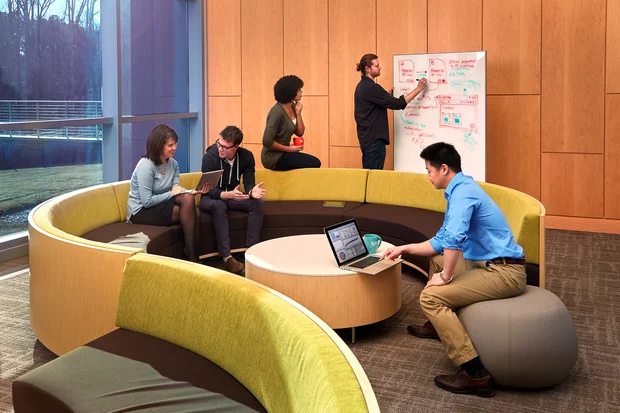
As someone who designs workplace environments, it’s fascinating to participate in the “amenity one-upmanship” happening at corporations throughout the world and at tech firms in particular. From ping pong tables and kegerators to massage and nap spaces, amenities are now ubiquitous to the workday experience. They reduce the formality of the office environment and encourage a higher level of socialization and camaraderie, each key contributors to workplace satisfaction. They make culture more tangible and visible, which in a red-hot market plays a strong role in recruitment, retention and differentiation.

Read the article on entrepreneur.com > 

Breathing new life into under-utilized buildings

Breathing new life into under-utilized buildings

From half-empty office blocks catering to an increasingly mobile workforce to car parking bays outside private homes, what’s there isn’t necessarily a waste of space, it’s a wasted opportunity to use the space in a more productive way.

Now, the sharing economy is looking to change that. Restaurants are the latest buildings looking to make more use of their space. In New York City, start-up Spacious is partnering with restaurants that are empty during the day to turn them into coworking spaces for freelancers, entrepreneurs and consultants looking for a different work environment.

Read the article on jllrealviews.com >

Active Design: Take Your Work Outside

Active Design: Take Your Work Outside

The conversations around Active Design continue! Designers, manufacturers and customers are discussing what it is, what are the benefits and how it is implemented? In the simplest of terms, Active Design is an approach to the development of buildings and workplaces that make daily physical activity more accessible for employees. For a more thorough explanation, check out this post on Active Design.

Read the blog post on blog.ki.com >

WORKPLACE UTILIZATION STRATEGIES THAT PASS THE COMMON SENSE TEST

WORKPLACE UTILIZATION STRATEGIES THAT PASS THE COMMON SENSE TEST

Many companies are still using outdated metrics to determine how much — and what type of — space, they need, and missing significant opportunities. From smart lighting to chair sensors and wearable tech, we are now living in an age of plentiful workplace data. New sources of information are a boon to professionals trying to determine the right amount, type, and configuration of space that will keep employees, CEOs, and managers happy — all at once.

Read the article on workdesign.com > 

Ten demonstrable truths about the workplace you may not know

Ten demonstrable truths about the workplace you may not know

The science of the workplace has gained a lot of interest over the last few years, highlighting recurring patterns of human behaviour as well as how organisational behaviour relates to office design. In theory, knowledge from this growing body of research could be used to inform design. In practice, this is rarely the case. A survey of 420 architects and designers highlighted a large gap between research and practice: while 80 percent of respondents agreed that more evidence was needed on the impact of design, 68 percent admitted they never reviewed literature and 71 percent said they never engaged in any sort of post-occupancy evaluation. Only 5 percent undertake a formal POE and just 1 percent do so in a rigorous fashion. Not a single practitioner reported a report on the occupied scheme, despite its importance in understanding the impact of a design.

Read the article on workplaceinsight.net > 

How Office Design Impacts the Way We Work

How Office Design Impacts the Way We Work

Over the last year, we’ve been excitedly planning our new office space. If you’ve ever been through an office renovation, you have a unique appreciation for what this endeavor looks like!

You’d be surprised to learn how important being intentional with space is. Admittedly, this isn’t something I would normally think of unless there was reason to in the moment. Going through this exercise has been a much needed and growth-oriented opportunity for me as a leader in my company. What I’ve come to see is that good design, like a good voice-over, shouldn’t stand out. It blends in because good office design, like a good voice-over communicating a message, is merely a vehicle- it’s a palatable expression that supports the ultimate goal. To say it differently, the spoken word is how people hear a message. Design is how people experience their work.

Read the blog post on huffingtonpost.com >

Google’s workplace consultant reveals the secret behind beautiful offices that every company should note

Google’s workplace consultant reveals the secret behind beautiful offices that every company should note

At this time and date, one thing is for certain- how happy and productive your employees are often depends on how beautiful your office looks. Gone are the days, when the company's workplace was regarded as a place which merely housed employees as they went about their daily set of responsibilities, thus being of little significance- design wise.  Today, that has completely changed and now, the workplace is the king.  Companies are slowly starting to realize that the way to a employee's heart is through a beautiful workplace and are as a result investing much more on ensuring that their workplaces walk the talk and reflect what they stand for. 

Read the article on businessinsider.in >

Want Engaged Employees? 9 Things to Measure in the Office

Want Engaged Employees? 9 Things to Measure in the Office

Disengagement in the workplace, and the $415 billion dollars it costs the global economy each year, has become an outright epidemic. According to “360 Steelcase Global Report: Engagement and the Global Workplace,” 37% of employees worldwide are highly or somewhat disengaged at work, with the majority of the others surveyed falling somewhere on the low- to middle-end of the curve. In fact, of the more than 12,000 individuals surveyed, just 13% report being both highly engaged and highly satisfied with their organization and workplace.

Read the blog post on myturnstone.com >

Firms Strive To Speed Production With Open Space

Firms Strive To Speed Production With Open Space

Are employees pining for their old cubicles? And if we take a cue from home, the kitchen is the center of family gatherings, making it now number one on the list of company amenities. Robin Weckesser, founder and president of a3 Workplace Strategies, discussed this and other water cooler buzz in this GlobeSt.com office trends exclusive.

Read the article on globest.com >

Ideas from education, art and hospitality are reshaping workplace design

Ideas from education, art and hospitality are reshaping workplace design

Every day, companies are introducing new ideas, strategies and technologies that change how and where we work. Each year, new graduates enter the workforce with bold ideas about their work style preferences and needs.

New research is constantly emerging that points to new ways for us to work smarter, healthier and more effectively. Collectively, these influences are reshaping workplaces and pushing them to a future state that never stops evolving.

For years, companies were caught up in the debate about open vs. closed workplaces and their respective merits. Recognizing this debate never led to a strategic solution; companies have been ramping up investment in research and employee engagement to better understand the types of work their office spaces need to support.

Read the article on bizjournals.com >

The office is not dead – but it must be reimagined

The office is not dead – but it must be reimagined

We live in a time of great upheaval. Whether it is advances in healthcare, transportation or technology, our day-to-day lives are close to unrecognisable from 30 years ago.

The one uniting factor of our era is that nothing can be taken for granted – society is in a state of constant flux, adapting to new challenges, thoughts and ideas.

Read the article on information-age.com >

How AI will change the modern workplace

How AI will change the modern workplace

Technology is changing the way we live. Innovative products like smartwatches, virtual assistants like Siri and Cortana, and self-driving cars are raising the bar on expectations.

So why shouldn’t that change be reflected in the way we work?

Business Insider spoke to Dave Wright, the chief strategy officer at cloud computing business ServiceNow about what they’re doing to improve processes and productivity and the workplace, as well as trends we’re likely to see in the future.

Read the article on businessinsider.com.au >

THE DAMAGING EFFECTS OF NOISY OFFICES

THE DAMAGING EFFECTS OF NOISY OFFICES

Noise levels are one of the leading causes of workplace complaints. The open office trend is making noise levels a growing problem: fewer walls to block sound and more people in a shared space.

The American Society of Heating and Air Conditioning Engineers recommends that offices have a noise range between 49 and 58 dBA so as not to interfere with conversations or distract workers.  But workers themselves prefer lower noise levels – not exceeding 52 dBA.

Read the blog post on blog.millikencarpet.com >

Co-Working Footprint In Chicago Continues To Grow

Co-Working Footprint In Chicago Continues To Grow

WeWork has signed a lease expansion at Alter’s 20 W. Kinzie building in River North, just one year after taking over much of the space vacated by tech giant Google. An Alter spokesperson tells GlobeSt.com that the shared workspace provider will also occupy the entire 16th floor, an extra 25,000 square feet, and now has a long-term lease at the property for a total of 129,000 square feet, making it the largest WeWork facility in Chicago.

Read the article on globest.com >

WELCOME TO AIRSPACE How Silicon Valley helps spread the same sterile aesthetic across the world

WELCOME TO AIRSPACE How Silicon Valley helps spread the same sterile aesthetic across the world

It’s easy to see how social media shapes our interactions on the internet, through web browsers, feeds, and apps. Yet technology is also shaping the physical world, influencing the places we go and how we behave in areas of our lives that didn’t heretofore seem so digital. Think of the traffic app Waze rerouting cars in Los Angeles and disrupting otherwise quiet neighborhoods; Airbnb parachuting groups of international tourists into residential communities; Instagram spreading IRL lifestyle memes; or Foursquare sending traveling businessmen to the same cafe over and over again.

We could call this strange geography created by technology "AirSpace." It’s the realm of coffee shops, bars, startup offices, and co-live / work spaces that share the same hallmarks everywhere you go: a profusion of symbols of comfort and quality, at least to a certain connoisseurial mindset. Minimalist furniture.

Read the article on theverge.com >

A 300 year old idea explains some of the enduring appeal of the open plan

A 300 year old idea explains some of the enduring appeal of the open plan

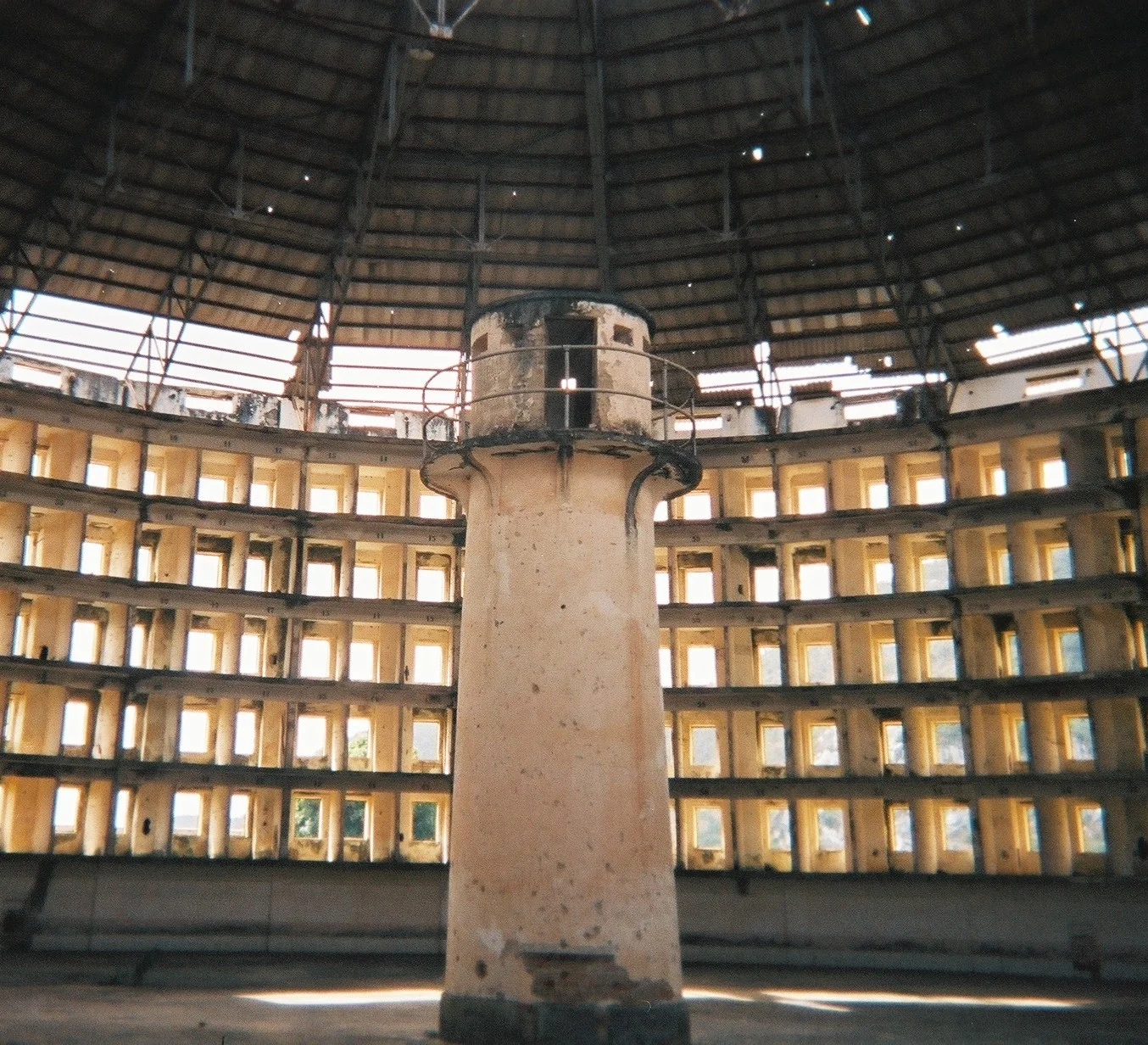
In the 18th Century the utilitarian philosopher Jeremy Bentham came up with his idea of the Panopticon, a prison building with a central tower encircled by cells so that each person in the cells knew they could be watched at all times. Whether they were observed or not was actually immaterial. Bentham called it ‘a new mode of obtaining power of mind over mind’ and while he focused on its use as a prison, he was also aware of the idea’s usefulness for schools, asylums and hospitals. Bentham got the original idea following a visit to Belarus to see his brother who was managing sites there and had used the idea of a circular building at the centre of an industrial compound to allow a small number of managers to oversee the activities of a large workforce. This is something of a precursor of the scientific management theories of Frederick Taylor that continue to influence the way we work and manage people.

Read the article on workplaceinsight.net > 

In Stata Center phone booths, "light-therapy" aims to brighten moods

In Stata Center phone booths, "light-therapy" aims to brighten moods

It may be sweltering for most of July and August, with long lingering days, but when winter comes, with its shortness of sunlight, MIT will be ready. 

In fall 2015, Ariel Anders, a fourth-year PhD student in the Department of Electrical Engineering and Computer Science (EECS), applied for and received a MindHandHeart Innovation Fund grant to install light-therapy lamps in accessible areas at MIT as a way to combat seasonal affective disorder (SAD), a type of depression that occurs at a certain time each year, usually in the fall or winter.

Read the article on news.mit.edu >