
Working Life

Five ways the workplace will change in the future

Five ways the workplace will change in the future

A workplace where people and robots collaborate, employees’ personal brands are bigger than their employers’ and the office is a destination for wellness are just some of the emerging trends which are set to transform the way we work and how leaders direct their businesses over the next 25 years, according to the findings of the Global Workplace Trends report by Sodexo.

The global services provider has interviewed some of the world’s biggest thinkers and investigated emerging trends and academic research to uncover the trends that will impact the nature of the workforce and influence future leaders.

Via fmj.co.uk 

How Remote Work Is Changing And What It Means For Your Future

How Remote Work Is Changing And What It Means For Your Future

Remote work has been a small part of the employment landscape throughout history. Thanks to the internet, those opportunities are now abundant, spurring many new companies to successfully connect solopreneurs to work projects. Some provide a general marketplace and others focus on specific disciplines; 99designs, for example, matches design projects with graphic designers. Even LinkedIn got in on the act last year with ProFinder – which is designed to link freelancers with leads.

But the new trend that’s exciting me and is growing exponentially is the area of remote work that’s not for freelancers; it’s for employees. There’s no arguing that the 9-to-5, 40-hour work week, with your entire team located near you, is gone. And it’s not coming back. Today, it is more likely that you work on a team where some or even all of your colleagues work remotely.

Via forbes.com

THREE WAYS TO WOO MILLENNIALS TO YOUR WORKPLACE

THREE WAYS TO WOO MILLENNIALS TO YOUR WORKPLACE

A new Deloitte survey shows millennials’ workplace wants have shifted in the last year. Here are the takeaways for associations looking to attract and retain a Gen Y workforce.

What a difference a year can make.

For instance, last year many young professionals said they were planning to say goodbye to their employers. “But, after 12 months of political and social upheaval, those ambitions have been tempered,” said the freshly released Deloitte Millennial Survey 2017.

Via associationsnow.com 

Employees prefer effective workplace technology to wacky office design

Employees prefer effective workplace technology to wacky office design

The majority (79 percent) of workers say reliable and modern technology is more important to them than office aesthetics, while accessories such as ping pong tables, slides, hammocks and wacky office designs may look good in pictures, but they don’t necessarily make employees any happier or productive. The is according to a survey, conducted by storage firm Kiwi Movers, which found that 86 percent of UK adults who work in an office said fun features were of no specific value to their working life, 11 percent said they were nice-to-have and of some value and 3 percent said they were very valuable. The most popular office perks are those offer an immediate tangible benefit to the employee, but even so, as many as 23 percent don’t take advantage every day; while 71 percent overall said they’d like more space in their office and of those, 58 percent believe that could be achieved by removing non-essential items. The research also found that younger workers were more likely on average to take advantage of ‘environmental’ perks like chill out areas and recreational equipment.

Via workplaceinsight.net 

Sitting Is Deadly. Could Banning Chairs Help?

Sitting Is Deadly. Could Banning Chairs Help?

By now the health deficits of sitting all day are so widely studied and well-documented that they're impossible to ignore. Studies show that sitting increases lower back pain, slows our metabolisms, and shortens our life-spans, among a host of other things. Not even daily exercise is enough to offset the damage. What's a health-conscious person to do?

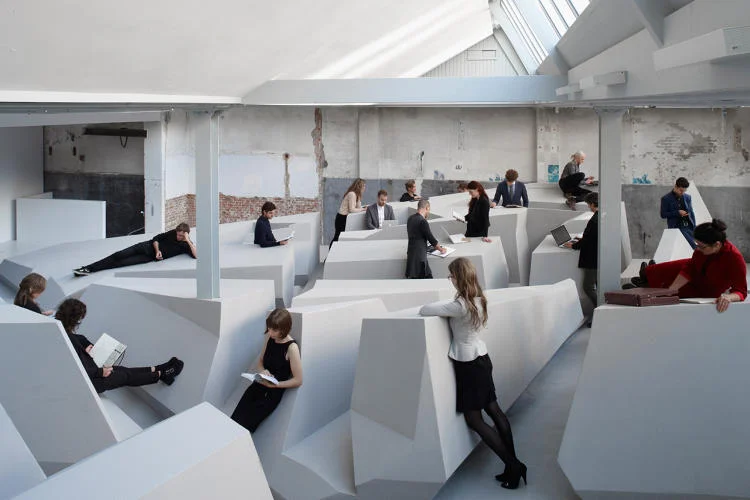
One answer: Eliminate chairs altogether. At the interdisciplinary Dutch design studio RAAAF (Rietveld Architecture-Art-Affordances), brothers and cofounders Ronald and Erik Rietveld have been studying how radically redesigning the workplace and home might affect how sedentary we are. Their installations The End of Sitting, which debuted in 2014, and Breaking Habits, opening at the Mondriaan Fund for Visual Arts in Amsterdam February 16, present chair-free environments that encourage people to get up and move. As Erik puts it, "As long as there are chairs present, people will sit in them habitually."

Via fastcodesign.com 

THE ​HEALTHY ​WORKPLACE: IDEAL OR IDEALISTIC?

THE ​HEALTHY ​WORKPLACE:  IDEAL OR IDEALISTIC?

In the 1950’s and 60’s, employee health was seldom factored into office design. Clerical staff in the central typing pool worked under flickering fluorescent lights and did not enjoy either privacy or access to windows and views. In the coveted corner office, a long day was likely to be fueled by coffee, cigarettes and the infamous 3-martini lunch—and there was no company gym, volleyball court or cocoon-like break room to relieve stress. At the same time, people at work frequently left their desk and walked across the office to deliver a memo, retrieve a file or set up a meeting. Incidental exercise—walking—was routine. And office workers rarely worked more than 10 hours a day. By the end of the 20th century, that was no longer the case. 

Via teknion.com 

A Psychologist Finally Explains Why You Hate Teamwork So Much

A Psychologist Finally Explains Why You Hate Teamwork So Much

There's no way around it: Every significant human accomplishment is the result of coordinated group behavior—people working together to achieve a common goal. Of course, that reality doesn't change the fact that for lots of people, teamwork is like pulling teeth. Here's why, and what to do about it.

Psychologists know there's a universal human need to belong to groups, but they also know that people aren't always predisposed to working well with each other. Individual interests often sabotage team spirit. People's competitive instincts end up finding targets in fellow team members rather than rival teams.

Via fastcompany.com 

Rethinking Collaboration in the Next Generation Workplace

Rethinking Collaboration in the Next Generation Workplace

Technology change does not occur in a vacuum, and this is becoming evident as enterprises struggle to realize anticipated results after making costly investments in collaboration solutions. While today’s applications truly are exciting, it’s easy to overlook how important the workplace environment is for their success. The context in which a collaboration solution is deployed really matters, as a holistic approach is needed to ensure that the right technologies are deployed in the right way to meet today’s workplace needs.

Via techzone360.com

There Are More Than 2,000 Plants In This Lush Coworking Space

There Are More Than 2,000 Plants In This Lush Coworking Space

The architects at the Madrid-based firm Selgascano are well acquainted with the power of plants. At the 2012 Venice Biennale, they orchestrated an artful pavilion of hydroponically grown greenery. Their own office is sunken into the forest floor, which naturally insulates the structure and can help fuel creativity by communing with nature. So it comes as no surprise that the architects chose to collaborate with Mother Nature on the new Lisbon, Portugal, outpost of Second Home, a coworking space for creative companies.

The office goes all-in on biophilic design, which encourages a connection between people and nature. Brimming with more than 2,000 individual plants and trees from 100 different species—such as tillandsias, philodendrons, and monsteras—the collection is watered and manicured by a team of local gardeners.

Via fastcodesign.com 

The Open Office: What’s Working And What’s Not?

The Open Office: What’s Working And What’s Not?

The term “open office” is a lightning rod for those in the corporate world. With articles, blog posts, and other commentary coming out seemingly every week (many of them negative), there is no shortage of opinion about this office design. As a facility executive, it is a topic that can’t be ignored; as the open plan becomes more mainstream, it’s likely that someone from your organization knows someone who has had a negative experience in this type of work environment. Due to the pervasiveness of this design, employees may just assume their office will be next. Regardless of actual plans for future workplace endeavors, it’s helpful to have a solid grasp on the concept. So what do facilities professionals need to know?

Via facilityexecutive.com 

‘Green’ Buildings May Boost Productivity, Cut Down on Sick Days

‘Green’ Buildings May Boost Productivity, Cut Down on Sick Days

When evaluating a job offer, there's more to consider than salary and health care benefits. New research suggests that working in a green-certified building could improve productivity, job performance and overall well-being.

A series of new studies, led by Harvard University and SUNY Upstate Medical University, found that occupants of high-performing green buildings showed higher cognitive function scores, fewer sick-building symptoms and higher sleep quality scores than workers in high-performing buildings without green certification.

Via shrm.org 

WHAT CHANGES IN THE WORKFORCE MEAN FOR THE FUTURE OF WORKPLACE DESIGN

WHAT CHANGES IN THE WORKFORCE MEAN FOR THE FUTURE OF WORKPLACE DESIGN

Over the course of the next five years, the workforce as a whole is projected to become more diverse both in terms of inherent attributes such as age, race, gender, religion, socioeconomic background, as well as acquired traits, like cognitive viewpoints and life experiences. While part of this is due to increasing incorporation of diversity initiatives, it is also reflective of larger demographic shifts.

Expect to see changes to the composition of the workforce: more retirees returning to work (or simply staying on part time), employees seeking work/life balance and greater flexibility/autonomy, and the increased influence of the 1099 economy.

Via workdesign.com 

Interruptions may actually improve team decision making, claims study

Interruptions may actually improve team decision making, claims study

Teams make better decisions if they are interrupted with advice during their task, rather than advised before it, new research from UCL School of Management claims. In a study published in the journal Organizational Behavior and Human Decision Processes, Professor Colin Fisher of UCL looked at the timing and impact of formal interventions in decision-making groups. He found that giving teams advice ahead of time to prevent problems from emerging doesn’t work as well as interrupting them with in-process interventions.Decision-making groups value interruptive advice more, which leads them to share more critical information and make better decisions, compared to groups getting the same advice before they begin their task – even when the difference between receiving the information was only a few minutes.

Via workplaceinsight.net 

Sorry, Working From Home Isn't the Future of Job Flexibility

Sorry, Working From Home Isn't the Future of Job Flexibility

Quick: When you dream of a more flexible work life, what does it look like? For most of us, the holy grail is working from home—but the future of flexible work arrangements could look very different.

Workers say in survey after survey that flexibility is a very important aspect of job satisfaction. But what they really want is to work from home, according to a recently published study by the Washington Center for Equitable Growth.

That's not realistic for many of the fields of work that are growing fastest, and it's not something most employers are offering. 

Via bloomberg.com 

DESIGNING SPACE TO SUPPORT COLLABORATION

DESIGNING SPACE TO SUPPORT COLLABORATION

In fields as disparate as healthcare and product development, interdisciplinary teams have emerged as the pathway to better, faster results—for patients, clients and other end users.

By bringing people from different disciplines and with varied specialties together, organizations today are finding new solutions to all kinds of challenges. Creative collaboration is driving innovation.

But cross-functional collaboration is hobbled without the space to support it.

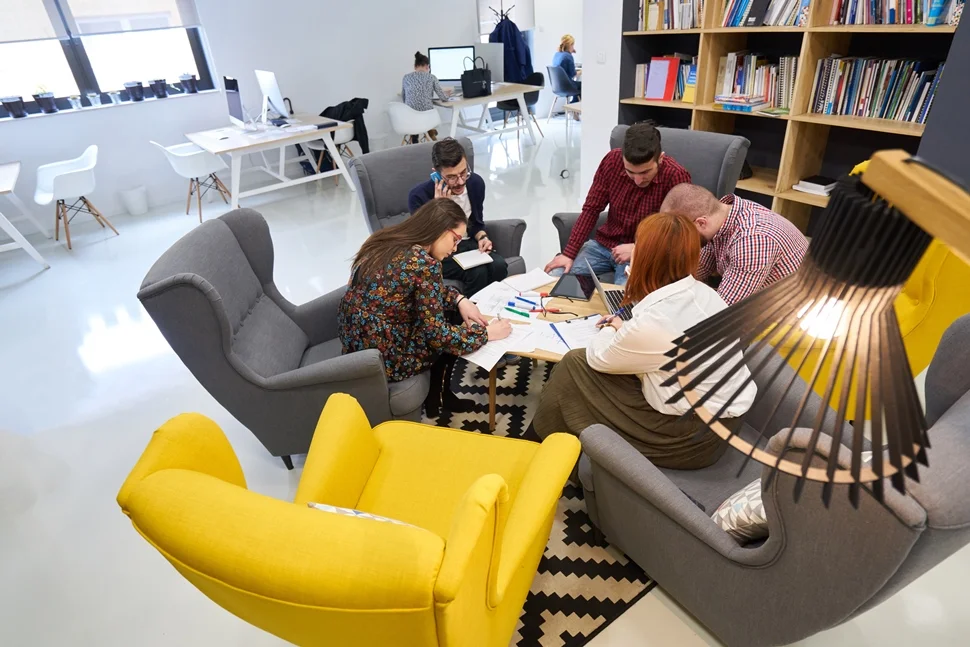
Businesses that are committed to breaking down silos and promoting the cross-pollination of ideas need to provide creative spaces, huddle rooms, project areas, lounges or other communal spaces where people can gather—where they can ask questions, dissect problems, exchange ideas and show examples from their own work. Spaces where teams can be the “melting pot” driving progress.

Via coalesse.com 

Generation X... The Forgotten Generation?

Generation X... The Forgotten Generation?

Every generation is told that one day they will have a chance to run the show — to really change the way the world works (literally and figuratively). My generation’s time in power lasted exactly three years.

I’ll excuse you if you blinked and missed Generation X’s lilliputian epoch as the dominant generation within the labor force. That’s because it was very short-lived. Gen X statistically took over in 2012 when 52.9 million of us surpassed the Baby Boom labor force to become the largest generation in the workforce. It unceremoniously ended in 2015 when Millennials took over.

If you are between the ages of 37 and 52, the definition of a Generation Xer, you might be asking yourself: Did I miss my work prime? And who are all these young kids running around in my office?

So let’s take a look at the brief, but illustrious attributes found in the forgotten generation — Generation X.

Via ki.com

The companies that encourage staff to socialize with each other

The companies that encourage staff to socialize with each other

Banish any thoughts of that cringe-worthy nightclub scene from The Office. There’s no reason why a social work culture has to be awkward or embarrassing, as these UK companies prove Socialising with work colleagues can be a tricky balance to strike. While studies show that it increases productivity, supports wellbeing and can lead to lasting friendships, there is always the fear that work might take over your personal life. That you may blur the boundaries of professional relationships or, even worse, end up embarrassing yourself on the karaoke machine when it goes too far. However, it seems that we are certainly not adverse to workplace relationships. In fact, one in five of us (22%) met our partner at work – according to a YouGov poll for the TUC – while a third of us have had a relationship with a colleague at some point.

Via inews.co.uk

Staying on top of change: Five ways to futureproof the workplace

Staying on top of change: Five ways to futureproof the workplace

Change is coming to workplace as advancing technology and data driven insights fuel new ways of working.

Both companies and their real estate will have to adapt. In fact, a workplace designed on today’s needs and assumptions could be redundant in little more than a decade, according to JLL’s Workspace, reworked report.

“Size and scale no longer guarantee success,” says Tom Carroll, Head of EMEA Corporate Research at JLL. “The companies that survive the changes set to take place will be those who successfully manage this uncertainty and seize the opportunities created by disruption. Leading firms are already identifying ways to use technology to transform the products and services they provide, the structure of their operations and the ways in which they compete.

Via jllrealviews.com 

How Does Noise Affect Productivity in the Office?

How Does Noise Affect Productivity in the Office?

Noise is one of the top causes of dissatisfaction and loss of productivity in the workplace. In today’s varied and diverse office environments, it is more important more than ever to create spaces that are acoustically appropriate and supportive of the people who work there. Unwanted noise can result in annoyance, heightened stress levels and reduced performance; therefore it is critical that we understand not only how people perceive sound in the workplace but also how this affects their health, wellbeing and performance.

Many architectural acousticians have a physics or engineering background, and their approach to mitigating noise is mostly, but not entirely, focused on purely physical solutions.  The demands of 21st-century workplaces often calls for a more rounded approach, with experts working together to offer a combined psychological, physiological and physical solution to acoustic problems.

Via humanspaces.com

Take up of flexible space confirms London’s status as a global coworking pioneer

Take up of flexible space confirms London’s status as a global coworking pioneer

The ‘gig economy’ continues to drive London’s thriving flexible workplace sector which accounted for 8.8 percent of total office take-up in 2016, according to a new study from Cushman & Wakefield. The report claims that the pace of development will continue for the foreseeable future, not least because of the number of corporate occupiers taking on coworking space. Flexible office space accounted for more than 4.5m sq ft of take up in London over the past five years as the capital has cemented its place as the leading global market for coworking, according to the research. In 2016, flexible office take-up amounted to 842,888 sq ft across Central London, representing 8.8 percent of total take-up – slightly above the five-year average of 8.4 percent.

Via workplaceinsight.net