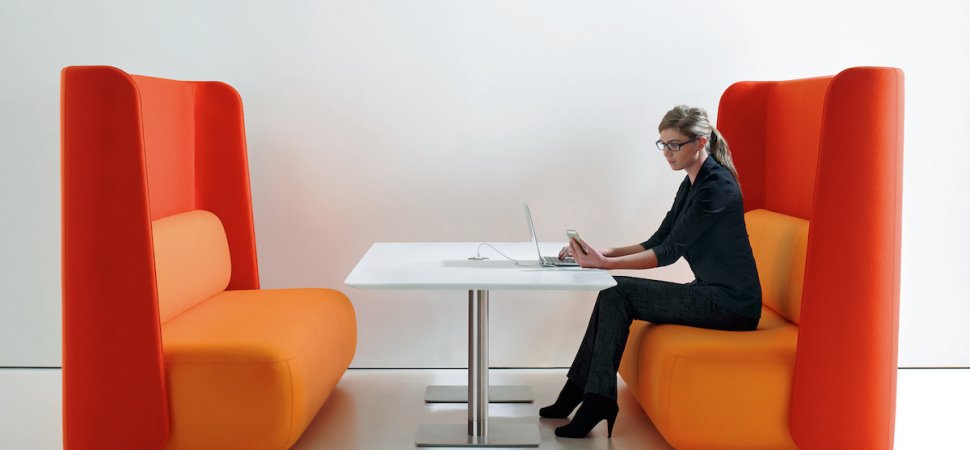
In a new study from architecture firm Gensler, there is evidence that supports that workplace performance is directly linked to the level of innovative office design. We're not talking strictly about fancy technology. Innovative office design is implemented through all areas: from how comfortable a desk is to whether the employee lounge is laid out to accommodate both large groups and private conversations, from conference room adaptability to inspirational reception areas. "We've proven that design not only influences the innovative process," writes Gensler, "But also that, done correctly, design has the power to drive new innovation forward in a direct and measurable way."
LISTEN: Nourishment, Nutrition, and the Workplace
We’re designing around the senses in the workplace. By looking at various stimuli, we can design to minimize distractions for a workforce. On the other hand, certain stimuli can actually improve productivity. We want to stimulate people, so they think differently. There could be a piece of art that draws your eye, either through texture or pattern, that helps you to think a little differently. It can create calm or prime your brain to function a little differently.
We see a big movement with clients to provide healthy food for staff. But instead of sugary snacks and sodas, organizations are stocking coconut water, spa water, teas, and low-sugar snacks. On a larger level, cafeterias with food service programs offer farm-to-table options for staff. Good food helps nourish the mind, so you can focus better.
Food also helps build relationships. We’re designing so people can share a meal together, build relationships, and do good work together.
Cafes in the workplace aren’t just tables and chairs anymore. We’re designing to support networks, relationships, and work. See some of the IA-designed micro kitchens Neil Schneider discusses here and here.
Millennials: A New Generation Is Reshaping the Workplace
Among the many startling revelations of the recent presidential election was the emergence of a powerful new generational voting bloc: the Millennials. For the first time, this cohort of 21- to 34-year-olds, also known as Generation Y, made up the same proportion of the U.S. voting-age population as the Baby Boomers. This remarkably cohesive group is significantly more progressive than their parents -- in states as different as Iowa, New Hampshire and Nevada, 80 percent voted for Bernie Sanders; nationwide, they overwhelmingly backed Hillary Clinton -- and has the potential to shape politics for years to come.
They're already reshaping the workplace.
Microsoft's co-working experiment
An alternative to the traditional office, the co-working space, has come into vogue in just a few years’ time.
In fact, there are now roughly 10,000 of these spaces worldwide according to a white paper released by the OpenWork agency, and that figure is nearly triple what it was three years ago.
Microsoft provides the most interesting case study. It’s giving nearly 30 percent of its New York City employees WeWork memberships. All told, that’s about 300 people, mostly in sales in marketing.
Microsoft (NASDAQ: MSFT) isn’t only experimenting with WeWork, though. In October at Grand Central Tech at 335 Madison Ave., Microsoft launched its Reactor, an in-house sort of co-working space where businesses, universities, governments and entrepreneurs can come together and access the latest Microsoft technologies and expert resources. Microsoft Reactors also provide training, networking events and related resources to support developers in the local tech community. Sound like anything you’ve heard of?
Part 2: Experts Predict 2017 Workplace Design Trends
Bringing the outdoors inside, and work outside. There’s already been an uptick in incorporating nature into workplaces so we’ll continue to see more plants, more natural wood in the interior architecture and furniture with gardens, rooftops, and more.
The coworking mentality will also increase. Coworking as not just an option for the individual in need of a desk, but as a new attitude and style of working. Companies are now inviting outsiders to cowork in their offices, and send workers outside of the office to cowork elsewhere. It establishes a sense of community and an exchange of information/creativity.
Experts Predict 2017 Workplace Design Trends (Part 1)
As 2016 comes to a close and we all start looking forward to the new year, it’s time to think about way in which we can improve our workspaces to keep attracting (and retaining) our beloved members.
So, what do you have planned for 2017? What will 2017 bring you? When it comes to design, we’ve got you covered.
Allwork reached out to various design experts to get the scoop on what stays, what goes, and what’s coming regarding workplace design.
Technology industry leads the way in adoption of flexible working
New research from My Family Care and global recruitment firm Hydrogen claims that when compared with all other industries, the technology sector has the most number of employees taking advantage of flexible working practices. Over four in five (81 percent) of employees who work in tech say they work flexibly to some degree – around 15 percent higher than the average of 66 percent and over half of the 265 people surveyed said they worked remotely at least one day last week – 18 percent higher than the average for all employees. The research also claims that people who work in tech put a high value on flexible working when considering a job offer, with 88 percent of professionals considering it to be more important than other benefits like private healthcare insurance, enhanced pension scheme or commission or bonuses.
Design, Materiality + Performance Inspire at Work
Why are some parts of the workplace always buzzing with activity — social spaces with constant clusters of people, rooms that are always booked or desks and enclaves that are always taken? What makes people choose to work in one space over another? Increasingly, people at work are searching for something. They’re looking for spaces that allow them to feel comfortable, help them think better and support their ability to solve problems.
These informal, authentic and inspiring spaces are creating workplaces where people want to gather, collaborate and perform at their best. The workplace is experiencing a rebirth to address the new ways in which people are working. Because technology allows people to work anywhere, the workplace is being reinvented to give people what their homes and cafes cannot — successful spaces providing places for focus, collaboration and socialization. These new spaces are human-centered combining design, materiality and performance to feel good, perform well and inspire people.
Re-designed and reworked: The evolution of today’s office
Some things in the office don’t change – the need for desks and chairs, the ringing telephones or the colleagues chatting on a coffee break.
But some things do. Over the last century the workplace has seen some huge changes in terms of design, employee dress, ways of working and of course, technology. And in the coming years the pace of change is set to increase further as smart tech and artificial intelligence have a big impact on how we work.
Direct causal link between wellbeing and corporate performance, claims study
A new report published by IZA World of Labor claims that a rise in workers’ happiness and wellbeing leads to an increase in productivity. The study from economist Dr Eugenio Proto, of the University of Warwick’s Department of Economics and Centre for Competitive Advantage in the Global Economy (CAGE) concludes that companies would profit from investment in their employees’ wellbeing. It cites the experience of large companies that have recently highlighted the importance of employee wellbeing in their company profiles. The authors claims that, until recently, evidence for a link between employee wellbeing and company performance has been sparse and that their own study shows a positive correlation between a rise in happiness and an increase in productivity. Proto believes that finding causal links between employee wellbeing and company performance is important for firms to justify spending corporate resources to provide a happier work environment for their employees and that the available evidence suggests that companies can be encouraged to introduce policies to increase employee happiness.
The 9-to-5 Workweek Is Dead. Here's What's Next
Your mind could have drifted thousands of miles away, but as long as your body showed up to work at Dallas-based tax firm Ryan, that was all that mattered. "We literally ranked people by hours," says Delta Emerson, president of Ryan's global shared services. "Even if someone worked 24 hours the day before, they still had to book at least eight hours Monday through Friday." The clock was seen as an easy proxy for work ethic, and employees who logged marathon sessions at their desks "wore their hours like a badge, practically tattooed on their foreheads," Emerson says. "But it was at a cost."
Emerson didn't want to just tweak the workweek. She wanted to bust it open. But when she pitched the idea of flexible hours, she was almost thrown out of the CEO's office. A resignation letter from a rising star finally got her the green light. Now the firm measures results--not time. Some staffers work as little as 20 hours a week; some start at 7 a.m., others at 10 a.m.; some commute to the office only twice a week. Since the 2008 shift, revenue has grown 15 percent year over year, customer satisfaction is higher than ever before, and turnover has plummeted.
3 TIPS FOR DESIGNING WORKPLACES THAT SUPPORT CULTURE, BRAND, AND COMMUNITY
The workplace has evolved exponentially over the past decade, from large, uniform workstations and offices to efficient open plans and auxiliary areas. Technology has advanced from desktop computers and landlines, to laptops, and mobile apps. Innovation in technology has driven an increase in employees’ productivity and efficiency, and innovation in design has strategically followed.
However, effective and engaging workplace design doesn’t stop with a response to technological and real estate needs. It must go further, supporting the creation and integration of a company’s culture, brand identity, and overall community.
5 Technology Advancements That May Impact a Workplace Near You
Robots, telecommuting and improved online recruiting will be on the rise in 2017. Every day there are new technologies and trends that impact how, when and where you work.
In order to become more productive in the workplace, and invaluable, you will want to stay current with advancements in technologies that streamline functions. You can be the innovator to help your organization integrate automation technologies to improve efficiency.
These Are The Top 5 Workplace Trends We'll See In 2017
This was a "remarkable" year for hiring, according to Glassdoor’s chief economist, Andrew Chamberlain. He says that the U.S. added an average 180,000 new jobs per month, well above the "break even" pace of job growth of 50,000 to 110,000 economists estimate the economy needs to keep Americans fully employed.
Pay is also on the rise. Median base pay for U.S. workers was up 3.1% from 2015, the fastest pace in three years. Can we top all that in 2017?
According to Glassdoor’s newest report on job trends, there are also a record number of unfilled jobs—5.85 million as of April—which represents the most since the BLS started tracking job openings in 2000. That’s compounded with the fact that every employer is hiring for tech roles, Chamberlain observes, and there are just so many talented candidates out there.
Start-ups, entrepreneurs embrace shared office space concept
“We’re right in the middle of a boom,” said Archna Saha of the Philadelphia Department of Commerce. “[Co-working spaces] are trying to accommodate the need for all of these founders. We’ve seen organic growth with businesses starting here, but we’re also starting to see offices coming in to Philly.”
“There’s a shift in the working culture and the type of environment people want to work in,” said WeWork Philadelphia Senior Community Manager Anita Shannon. “It’s not just with millennials.”
How the Sharing Economy Is Changing Office Space
Two booms taken together turned Center City Philadelphia from a somewhat sleepy place at night with a buzz-cut of a skyline to a vibrant, round-the-clock environment with a true big-city downtown profile.
The first was the office construction boom that was touched off by Liberty Place, the building that broke the buzz cut. The second was a wave of new residents that first began to stream into the city center around that same time.
But as that wave turned into a flood, the two booms ended up canceling out the city’s office-sector growth. Older office buildings were turned into residences even as new office buildings went up, thus keeping the office market (and the rough number of office workers) flat. The culmination of this canceling-out was the conversion of Two Liberty Place’s upper floors into condominiums in the early 2000s.
How Digital Nomads Are Leading the Seismic Shift in Where We Work
Have laptop, will travel.
That’s become the slogan of an increasing number of the global white-collar workforce. People are unleashing themselves from corporations and companies to plug wirelessly into the wider world. The tribe of this digital diaspora is described and named in various ways—among them, location independent—but I prefer digital nomad.
“[Digital nomads] don’t subscribe to the standards of previous generations for what defines happiness, what defines productivity, what defines success. I think they’re freeing themselves from the shackles of previous generations,” says Brian Solis, a self-described digital anthropologist and principal analyst at technology research firm Altimeter Group, which is part of the marketing firm Prophet Company. He is also the author of X: The Experience When Business Meets Design.
Flexible working is not a magic bullet for workplace ills
What is ironic about this now is that the world is awash with data. We could easily assume that this would make the truth, or at least facts, less disputable. But the converse appears to be true. The more information we have, the more we fall back on narratives. This is often the case in the field of workplace design and management. We’ve never had more data about what makes people productive, happy, well, engaged and motivated. We’ve never known more about what makes buildings function and how to optimize their systems and performance. And yet narratives persist that do not match the data, or at least oversimplify them.
Perhaps the most prevalent of these is that flexible working offers some sort of magic bullet to most of the problems we encounter at work. When it comes to finding solutions to the workplace’s most complex and intractable challenges, the idea of a ‘magic bullet’ is obviously something we find compelling. The term is nearly as old as gunpowder itself, dating back to a piece of German folklore in which the Devil grants a sharpshooter six bullets which hit whatever target he chooses, while the Devil reserves a seventh bullet to do with as he pleases.
Five traits of the modern tech workplace
When Google emerged as a search engine innovator, the company’s unconventional Googleplex headquarters in Mountain View, California, showed the business world what a workplace could be.
With foosball tables, a bowling alley, lava lamps, nap pods, a coffee laboratory, colorful sofas, slides between floors, and more, the Googleplex inspired tech company office design everywhere.
As the U.S. tech sector expanded in recent years, driving nearly 25 percent of office leasing activity, tech companies have become a tenant of choice in many cities, according to JLL research.
However, many have specific requirements in mind for their workspace and only some buildings will make the cut. “Tech tenants look for buildings with character and connectivity to accommodate their workplace design styles,” says Steffen Kammerer, who leads JLL’s Technology Practice group. “Such elements as high ceilings, large windows and open, pet-friendly spaces will inspire a tech company to consider signing a lease.”
How to create a space where everyone can work
The UK’s offices host a more diverse workforce than ever before. It is not uncommon to walk into a large open-plan space and see four different generations at work at their desks. Legislation addressing age and disability discrimination in the workplace has removed some of the barriers to people of different abilities. Women have broken through the glass ceiling in many previously male-dominated companies.
Inside our larger urban business districts and corporate campuses, employees from all creeds and corners of the globe contribute to the UK economy as part of the free movement of labour that has been integral to the British workplace for the past 20 years.