
Working Life

Report on coworking highlights tough realities behind new workspaces

Report on coworking highlights tough realities behind new workspaces

Coworking behemoth WeWork earned a jaw-dropping $16 billion valuation, just as the coworking economy nationwide posted a stellar 10 percent growth rate last year. And new, more specialized spaces, including The Wing, a coworking hub for women, have opened, giving freelance workers more options than ever to find a comfortable place to be creative.

While the these new types of trendy workspaces have enjoyed impressive growth, it’s not all good news in the world of coworking. A new report by global planning, design, and architecture firm HOK, Coworking: A Corporate Real Estate Perspective, looks beyond the meteoric rise and offers a sober assessment of the coworking business. The overarching theme is: don’t believe the hype. 

Via curbed.com >

Two-thirds of British workers more productive working in the office

Two-thirds of British workers more productive working in the office

Despite half (50 percent) of the British workforce saying they are equipped with the right tools and technology to enable them to work anywhere, half (50 percent) of respondents to a new survey stated that remote working can make them feel stressed, isolated or lonely (43 percent) and over half (53 percent) said that working out of the office makes them feel disconnected from colleagues. The survey from Peldon Rose, found that two-thirds (66 percent) of British workers say they work most productively in the office compared with a quarter (26 percent) who work most productively at home. The survey results also underline how vital close working relationships with colleagues are to employees’ happiness, wellbeing and productivity with nine in 10 (91 percent) of office workers stating they value their friendships within the workplace and 80 percent crediting their friendships with colleagues with helping them to be more productive at work – something they feel boosts their productivity even more than personal technology (66 percent).

Via workplaceinsight.net >

Millennials have just the same needs for peace and quiet as everybody else

Millennials have just the same needs for peace and quiet as everybody else

Asked for the dream millennial workplace, most people would probably envision a brightly colored open environment with pool tables, bean bag chairs and maybe a small basketball court. But it turns out that young people in the workplace have the same psychological requirements as the old crowd, and may even be more sensitive to distractions. A recent study by Oxford Economics suggests that distractions in the workplace are seriously hindering people’s ability to concentrate and perform, with little recognition from above. The transition to open offices since the end of the 20th century and the environmental factors they bring into play may be affecting people’s mental health, reducing employee happiness and thereby the bottom line of business performance.

Via workplaceinsight.net >

Can A Building Engineer Innovation?

Can A Building Engineer Innovation?

Innovation is a buzzy thing in architecture today. It's nearly impossible to avoid projects that claim to be purpose-built to spark the invention of new ideas, from individual buildings to campuses to entire city districts. But can you actually engineer innovation? Is it something that can be designed, or is this just another clever real estate marketing tactic?

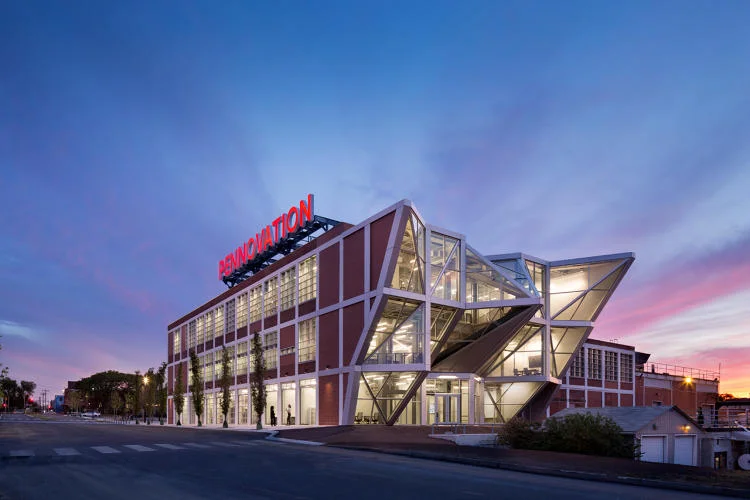
The recently completed Pennovation Center in Philadelphia is the latest to be admitted into the Innovation Architecture Class. A renovation of a former factory, the project anchors the University of Pennsylvania's 23-acre Pennovation Works district, an area of the campus specifically designed to be the site where the next big thing is invented—and turned into a business.

Via fastcodesign.com >

Workplace Strategy Isn’t Just For Large Companies

Workplace Strategy Isn’t Just For Large Companies

The elements of mobility, wellness, choice of space, amenities and technology are universal to all size companies, CBRE’s managing director Paul Komadina tells GlobeSt.com. He says that today’s workplace experience is transforming, and CBRE’s workplace-strategy services are a value-add to tenants, are scalable and help create an environment that will attract and retain a talented workforce.

Read more about this on globest.com >

New HOK/CoreNet Global Report Explores Impact of Coworking on Corporate Real Estate

New HOK/CoreNet Global Report Explores Impact of Coworking on Corporate Real Estate

Coworking is one of the fastest-growing sectors of the commercial real estate market. The new report, Coworking: A Corporate Real Estate Perspective, examines the drivers of coworking from the demand and supply sides, the industry risks and implications for corporate real estate, as well as information about the owners, coworkers and centers.

The HOK/CoreNet Global Coworking report highlights the ideas that changing business priorities and the need to attract talented people, reduce real estate costs, improve speed to innovation and increase productivity are driving corporations to consider different workplace models, including on- and off-site coworking.

Via hok.com >

Americans Work 25% More Than Europeans, Study Finds

Americans Work 25% More Than Europeans, Study Finds

Americans are addicted to their jobs. U.S. workers not only put in more hours than workers do almost anywhere else. They’re also increasingly retiring later and taking fewer vacation days.

A new study tries to measure precisely how much more Americans work than Europeans do overall. The answer: The average person in Europe works 19 percent less than the average person in the U.S. That’s about 258 fewer hours per year, or about an hour less each weekday. Another way to look at it: U.S. workers put in almost 25 percent more hours than Europeans.

Via bloomberg.com >

Gartner report identifies the Top 10 strategic technology trends for 2017

Gartner report identifies the Top 10 strategic technology trends for 2017

A new report from tech analysts Gartner highlights the top technology trends the firm believes will be ‘strategic for most organizations in 2017’. Gartner defines a strategic technology trend as one with substantial disruptive potential that is just beginning to break out of an emerging state into broader impact and use or which are rapidly growing trends with a high degree of volatility reaching tipping points over the next five years. They include artificial intelligence, blockchain, intelligent devices, digital technology platforms and advanced machine learning.

Via workplaceinsight.net >

Offices of the Future Won't be Modeled on Factories of the Past

Offices of the Future Won't be Modeled on Factories of the Past

Imagine someone typing at a multidirectional treadmill desk, wearing VR goggles, drinking triple-ozonized spa water, hosting a virtual meeting, all from a one-bedroom apartment.

Got that image? Well good, you’re probably not picturing the office of the future. For the next 10 years, people are still going to think, jabber and poke keyboards in shared physical spaces. But unlike the spaces we’re used to, the office of the future will have an untraditional purpose: to help you accomplish audacious, outer-space things.

Via entrepreneur.com >

Transforming The Future Of Work: Top Five Trends

Transforming The Future Of Work: Top Five Trends

Buildings and space that anticipate your needs. Collaboration with robots. Cafes, parks, and airports as the new office.

The workplace is evolving more rapidly than ever, and employers have seen dramatic shifts in where, when, and how employees work. Here are five workplace trends that organizations should know so that their facilities can best support a digital, flexible workforce, according to JLL.

Via facilityexecutive.com >

Workplace stress, sleep among top employee concerns

Workplace stress, sleep among top employee concerns

More than a quarter of workers are stressed out, according to a national workplace health survey released Tuesday by the American Heart Association’s CEO Roundtable.

According to the Nielsen-conducted survey of 2,009 employees, 28 percent experience stress as a result of work. Many want their employers to recognize the stress they are under and allow for flexibility where they work and when they work to help reduce stress.

Via news.heart.org >

How Microsoft Used an Office Move to Boost Collaboration

How Microsoft Used an Office Move to Boost Collaboration

What type of office design is best for productivity and engagement? Today, this common question tends to have two distinct answers. On the one hand are the tech start-ups, who advocate for open office plans that emphasize chance encounters. Google’s new campus is designed to maximize chance encounters, and Facebook’s new headquarters features the largest open office in the world. Samsung is also exploring the use of more outdoor space to encourage employee conversation. As Scott Birnbaum, vice president of Samsung, told HBR, “The most creative ideas aren’t going to come while sitting in front of your monitor.” Their new building “is really designed to spark not just collaboration but that innovation you see when people collide.”

On the other hand is research about people’s preferences, like this 2013 study in the Journal of Environmental Psychology that, according to its authors, “categorically contradict[s] the industry-accepted wisdom that open-plan layout enhances communication between colleagues and improves occupants.” Another study demonstrated that the noise resulting from open office designs is a huge drain on employee morale.

Via hbr.org >

Technology and Collaboration: A Vital Pair for the Future of Work

Technology and Collaboration: A Vital Pair for the Future of Work

Between cloud services, video calling, internal social networks, and so much more, collaboration plays a huge role in modern workspaces. At the heart of collaboration is the technology that makes it possible. And for every type of collaboration software, there are multiple vendors and services offering various features and systems. Collaboration, while vital to the future of work, can also be overwhelming. But just as each organization has its own business plan and internal processes, so too does it need to have collaboration tools that meet its needs.

Via thefutureorganization.com >

Designing a Workplace for the 21st Century Workforce

Designing a Workplace for the 21st Century Workforce

The demographics of the U.S. workforce continue to shift: women now comprise nearly half of the U.S. workforce and the Millennial Generation has overtaken Baby Boomers as the largest generational cohort in the U.S. workplace.

Traditional workplace policies and practices have not kept up, and they are not empowering—and ultimately retaining—top talent among women or Millennials.

New research reveals that companies can improve workplace satisfaction and performance simultaneously among cohorts of women and Millennials by creating flexible work policies and fostering a culture of transparency and collaboration.

Via huffingtonpost.com >

Challenging Tradition: The Evolution of Law Office Design

Challenging Tradition: The Evolution of Law Office Design

Relationships are the foundation of any successful business partnership, and this is especially true about the relationship between a client and a designer. When tasked with redesigning the law offices of Nixon Peabody, Design Director Ken Wilson of Perkins + Will knew the first step was cultivating a strong relationship with his client.

Via callisonrtkl.com >

11 hours a day in front of a screen. This is what it's doing to your eyes

11 hours a day in front of a screen. This is what it's doing to your eyes

Your mom warned you sitting too close to the TV wasn’t a good idea. It turns out she wasn’t entirely off the mark.

Digital eye strain” is now a real condition, defined as the physical eye discomfort felt after two or more hours in front of a digital screen. As screen time increases - at home and in the office - so do symptoms like blurred vision, burning eyes, headaches and disrupted sleep. In total, nearly two thirds of American adults now experience symptoms of digital eye strain due to prolonged use of electronic devices like computers, tablets and cell phones.

Via weforum.org >

Office design – the key to employee happiness

Office design – the key to employee happiness

Many employers will tell you that when running a business, people are your prime asset. Your company’s success or failure depends on the work delivered by the people on your payroll, making it important to ensure they’re putting their best foot forward at all times. One way to achieve that is by keeping staff happy, since unhappy employees can damage your business’ bottom line.

As it turns out, the best way to do that is by improving your office design. Office search engine Office Genie asked 2,000 UK workers about their working environment in an attempt to find out which factors contribute most to workplace happiness. Workplace design came out on top with employees indicating the right design can boost their happiness by a whopping 33%. In comparison, other factors such as temperature (5%), light (6%), noise (8%), and social interaction levels (8%) have a very limited impact.

Via humanresourcesonline.net >

A human centric approach to designing the future workplace

A human centric approach to designing the future workplace

The concept of the workplace is evolving. Historically, the quest was to design the perfect workplace focused on the infrastructure and physical design, taking into account technological transformations, with business cost efficiency being a major driver. This approach, however, often neglected the human aspects and how the talent interacted in and around the space and how productivity was maximised.

This "single serving" mentality - buildings to house workers and workstations for employees - ignores the potential to transform urban spaces in cities worldwide into more holistic and human-centric precincts. As a result, commercial areas, especially central business districts (CBDs) around the world, turn into dead areas after dark and on the weekends. But it need not be this way.

Via businesstimes.com.sg >

Beyond Nap Pods: The Importance of Creating a Positive Company Culture

Beyond Nap Pods: The Importance of Creating a Positive Company Culture

When employees love coming to work, companies prosper. Stock returns for Fortune's "100 Best Companies to Work For" are nearly double those of the general market. Unsurprisingly, those firms have less turnover. That's a major boost to their bottom lines, since replacing an employee can cost more than twice her salary.

Via ki.com >

ART IN THE WORKPLACE: WHY YOU NEED IT AND HOW TO CHOOSE IT

ART IN THE WORKPLACE: WHY YOU NEED IT AND HOW TO CHOOSE IT

Displaying art in the workplace can elevate employee performance, mood, and physical well-being, as well as bolster interpersonal bonds between employees and clients. Dozens of research studies conducted in the United States and Europe throughout the past 10 years have identified myriad ways — from the practical to the unconscious — that installing thoughtfully-chosen art in the workplace can improve employee experience and achievement, and help to communicate the right message to guests. In this brief guide, experts from PLASTARC summarize the many positive effects certain kinds of art can bring to employees and visitors, and share ideas about how to choose the best art for the workplace.

Via workdesign.com > [paywall]