
Working Life

Industrial robots will replace manufacturing jobs — and that’s a good thing

Industrial robots will replace manufacturing jobs — and that’s a good thing

If you listen to the wrong people, the North American manufacturing industry is doomed.

There is no denying that the U.S. and Canada have been losing jobs to offshore competition for almost half a century. From 2000 to 2010 alone, 5.6 million jobs disappeared.

Interestingly, though, only 13 percent of those jobs were lost due to international trade. The vast remainder, 85 percent of job losses, stemmed from “productivity growth” — another way of saying machines replacing human workers.

For many, this scenario is even worse. China and Mexico may be “taking our jobs,” but at least they’re going to other humans. Robots, on the other hand, allegedly threaten to wipe entire sectors, like manufacturing, right off the map. The level of fear-mongering here is high: “How to Keep Your Job When Robots Take Over.” “Is a robot about to take your job?” “What Governments Can Do When Robots Take Our Jobs.” It’s enough to make anyone a little nervous.

The facts, however, tell a different story. Over the last 20 years, inflation-adjusted U.S. manufacturing output has increased by almost 40 percent, and annual value added by U.S. factories has reached a record $2.4 trillion. While there are fewer jobs, more is getting done. Manufacturing employees are better educated, better paid and producing more valuable products — including the technology that enables them to be so much more productive.

In fact, there are currently two million jobs going unfulfilled in the manufacturing sector, largely due to an aging workforce — the average age of a manufacturing worker is almost 45, two and a half years above the national non-farm median — and negligible interest in those jobs from younger generations.

More via techcrunch.com >

UK Workplace Survey 2016: Bridging the Gap

UK Workplace Survey 2016: Bridging the Gap

With a dramatic gulf between the haves and the have-nots in the UK workplace, it is imperative that businesses bridge this gap if they are to unlock innovation in the workplace. At the same time, it is equally important that businesses enrich the human experience and help people optimise their performance at work.

As a research-based design firm, we use data, evidence, analysis and insights to fuel creative solutions to the core questions facing today’s hyper-connected workforce. Our most recent insight study, the 2016 UK Workplace Survey, officially launched on Sept. 6 at a client event in London. Joined by a panel of industry experts and workplace specialists, we asked the question, “How can the workplace be a catalyst for innovation in today’s organisation?” The ensuing debate brought to the fore some interesting observations.

This post is part of a series of blog posts on Gensler’s 2016 Workplace Surveys.

Via gensleron.com >

How to Choose the Right Amenities for Your Office

How to Choose the Right Amenities for Your Office

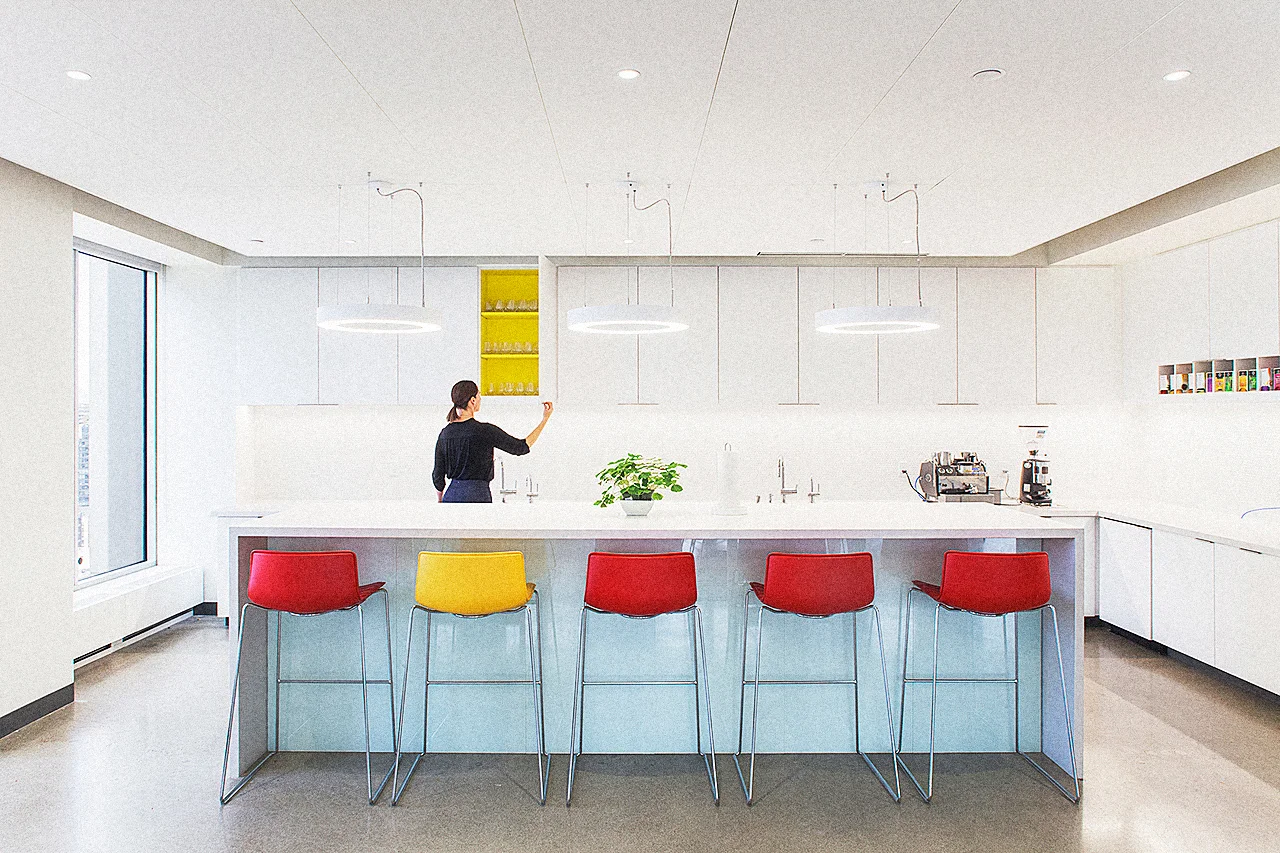
“You can’t always get what you want,” sang the Rolling Stones. It’s true in life and no less true in the workplace environment, particularly when it comes to amenities. But a smart and strategic approach to amenity selection and design can result in something much better: you get what you need.

The idea that amenities can help in recruiting and retaining top talent has resulted in a veritable corporate keeping-up-with-the-Joneses competition, with companies trying to one-up one another with over-the-top perks. “I’ll match your fitness center with a climbing wall and raise you a kegerator.”

But no matter how lavish the amenities, they’ll prove ineffective in making any kind of positive impact if they don’t align to a company’s culture and the characteristics that make an organization unique.

Instead of wasting time and money copying what others are doing, the solution is to build a sustainable environment that truly works for the company and its employees. This can be readily achieved by approaching amenity selection and design through a framework of three critical factors: location, wellbeing and culture.

Via gensleron.com >

How to Use a Standing Desk Without Annoying Your Co-Workers

How to Use a Standing Desk Without Annoying Your Co-Workers

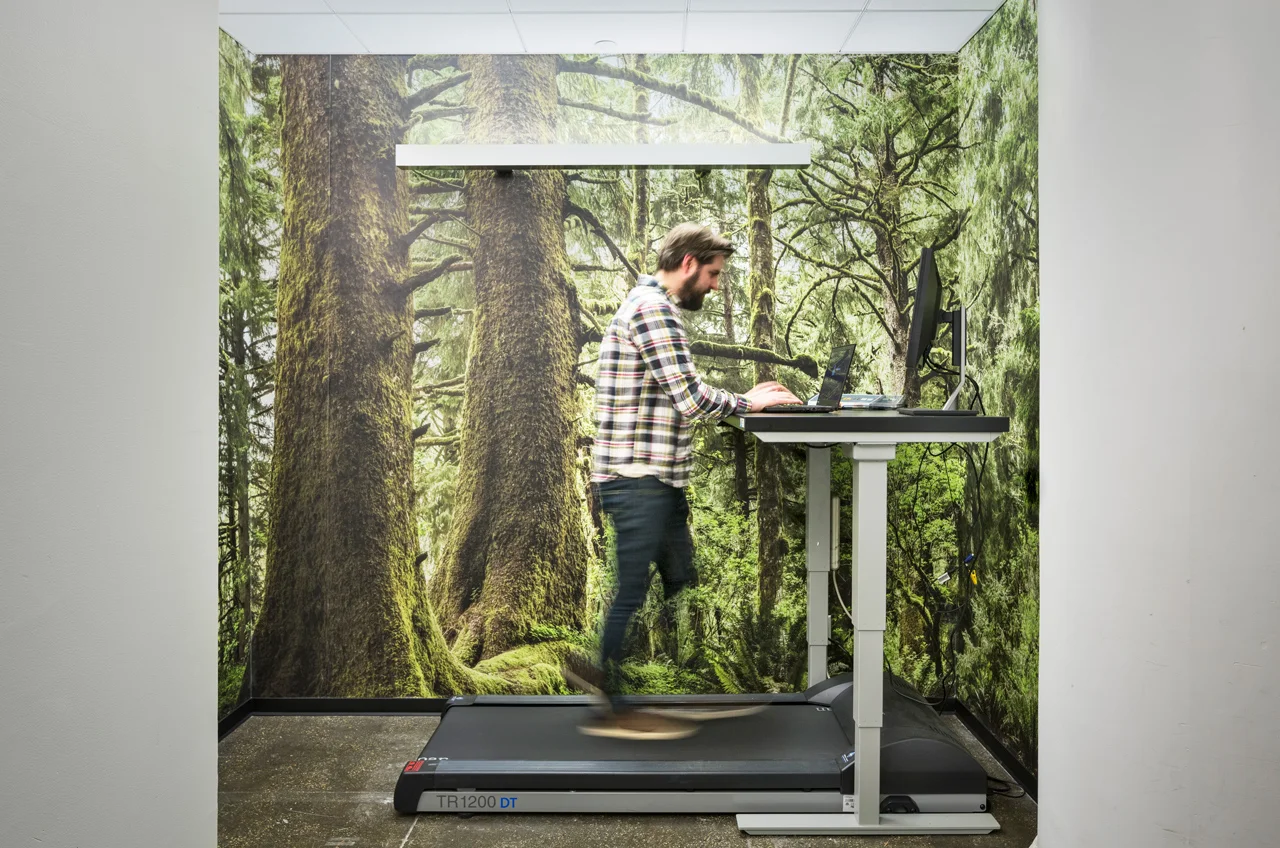
As with any new piece of automated equipment, navigating the proper etiquette of standing desks can involve a bit of a learning curve.

You will literally stand out. Embrace it.

“If you have a standing desk, that’s still viewed as being somewhat dorky,” said Joel Johnson, 37, a publishing consultant in Fort Greene, Brooklyn. “It’s not a big deal, but some people are never going to be accepting of it. Some people will roll their eyes. It’s fair game for light teasing.”

Think about where you take meetings and what it means.

If you’re standing and co-workers are sitting, it’s like you’re at a lectern, so rise (or sink) to their level. “There is a sitting area in my office with a table and a few chairs, but for a lot of meetings, people will just come and stand at my desk,” said David Carter, 47, the chief creative officer at Mithun agency in Minneapolis. “Psychologically, it says we’re not going to hang out and have a longer meeting than necessary. It’s a little bit of a power move.”

Via nytimes.com >

The Co-Workation: The Latest Way To Annihilate Your Work-Life Balance

The Co-Workation: The Latest Way To Annihilate Your Work-Life Balance

Haven’t got time to spare for a vacation? Then why not take your work with you? Or better still, how about a "co-workation," a "combination of a creative business trip and inspirational adventure holiday for location-independent professionals," as Treehugger’s Kimberly Mok describes it.

The idea of mixing work and travel isn’t a bad one. Just this year I spent a couple of weeks visiting family and friends back in Spain. In the middle, I took a week of regular, no-work vacation, but for a half a week either side of that I worked my usual schedule, spending the evenings with friends.

Via fastcoexist.com >

6 Ways Buildings Can Promote Wellness

6 Ways Buildings Can Promote Wellness

The health and wellbeing of your building’s occupants isn’t just the purview of human resources anymore. Facilities managers can play an important role in making sure the people who work in your building are happy, healthy and active.

“In the last four or five years, the conversation has changed from how much energy can we save to how does the building affect people’s health and productivity,” explains Turan Duda, Design Partner for Duda|Paine Architects. “That’s a very different conversation than putting solar panels on the roof.” 

Incorporate active design elements into your building and encourage your occupants to lead healthier lives with these six tips.

Via buildings.com >

The pursuit of workplace happiness

The pursuit of workplace happiness

Are you happy? If not, you can be…with a bit of work, says Sonja Lyubomirsky, professor of psychology at the University of California, US, and one of the leading researchers in the field of positive psychology. Professor Lyubomirsky’s research on happiness over two decades is distilled in her two best-selling books—The How Of Happiness and The Myths Of Happiness. 

In a Skype interview, Prof. Lyubomirsky explains why much of our happiness is within our control, and why “creation” of happiness is a good thing. 

Via livemint.com >

Green buildings improve occupant’s cognitive function and health

Green buildings improve occupant’s cognitive function and health

New evidence which supports the argument for the Well building concept as new research suggests that compared to people in high-performing buildings without a green certification, occupants of high-performing, certified green buildings had nearly a third (30 percent) fewer sick building symptoms, a 6.4 percent higher sleep quality score and a 26.4 percent higher cognitive function score. The new study from Harvard University and SUNY Upstate Medical University, supported by United Technologies suggests that there may be an even greater benefit to working in green certified buildings than originally thought. “The Impact of Working in a Green Certified Building on Cognitive Function and Health,” demonstrates the importance of green-certified buildings to the health of occupants – particularly for office workers whose health, productivity, decision-making, and sleep could greatly benefit.

Via workplaceinsight.net >

Are we seeing the workification of home or the homification of work?

Are we seeing the workification of home or the homification of work?

Thinking and theories about working environments continue to be much debated, of course. As part of this ongoing discussion, Bisley recently hosted an event at its London showroom to continue the aspects of the debate that focus on how offices seem to be morphing in to homes, and how our homes are, conversely, functioning as places of work. The panel discussion was led by Professor Jeremy Myerson of The Royal College of Art and WORKTECH Academy. He was joined by Kirstin Furber – People Director at BBC Worldwide, Sebastian Conran – a leading product and furniture designer, David Barrett – Head Buyer of Living, Dining and Home Office at John Lewis and Amelia Coward – Founder and Creative Director at Bombus.com.

Via workplaceinsight.net >

The American workplace is more skilled, but workers are concerned they are becoming irrelevant

The American workplace is more skilled, but workers are concerned they are becoming irrelevant

The ‘Tectonic changes’ that are reshaping the US workplace and the response to them are the subject of a major new research project from the Pew Center in association with the Markle Foundation. The study of over 5,000 US workers carried out over the Summer found that the nature of jobs is undergoing a fundamental shift with greater emphasis on knowledge as well as analytical, interpersonal and communication skills. In response, workers are retraining and reassessing their abilities to adapt to the demands of employers. Despite this, a growing number are worried that they are becoming irrelevant and have diminishing faith in the ability of politicians, the education system and their employers to address their concerns.

Via workplaceinsight.net >

A New Healthy Building Certification From The CDC Is Coming To Your Office

A New Healthy Building Certification From The CDC Is Coming To Your Office

A new tool that will help employers create healthier workplaces is getting off the ground.

Fitwel is a health and wellness standard for buildings developed by the CDC, the General Services Administration (the government agency that runs federal office buildings). After testing it in government facilities, it was released to the public a few months ago, with the help of a New York City nonprofit, the Center for Active Design. It’s aimed at helping employers evaluate all the design factors that go into creating a healthy workplace, from proximity to public transit, bike parking, indoor air quality, healthy food access, and stairwell design.

Via fascoexist.com >

First Company to Adopt Fitwel, a New Government-Backed Rating System for Healthier Workplaces

First Company to Adopt Fitwel, a New Government-Backed Rating System for Healthier Workplaces

In a bold move solidifying its commitment to evidence-based, healthier workplace design, global architecture and design firm Perkins+Will has become the first company to pursue—with the intent to achieve—Fitwel certification for all of its North American offices. The firm announced today that its Atlanta, Chicago, Minneapolis, New York, San Francisco, and Vancouver offices will become Fitwel certified before the end of 2016. The rest of the company’s North American offices, including Boston, Los Angeles, Seattle, Toronto, and Washington D.C., will certify in 2017 and 2018.

Via perkinswill.com >

OPEN VS PRIVATE OFFICE: IS THE PENDULUM OFF ITS AXIS?

OPEN VS PRIVATE OFFICE: IS THE PENDULUM OFF ITS AXIS?

This morning, 77 million Americans got up and went to work in an office. Increasingly, Americans log their 40-plus hours in spaces with an open concept design, unassigned seating, exposed ceilings and maybe a ping pong table. But are choices and creative office really solving a problem?

During the rise of the creative office in the late 2000s, the New York Times reinvigorated discussion of an important concept: decision fatigue. The concept states that having too many choices can have an adverse effect on one's ability to make good decisions.  

Gensler principal Paul Manno says creating good workplaces has always been about offering choice, but this push for collaboration and flexibility hasn't necessarily being thoughtful and has gone too far. Architects and designers can't fill a space with some lounge chairs and sofas and call it choice; they must get smarter, Paul says.

Via bisnow.com >

Google Launches Healthy Building Materials Tool to Change an Industry

Google Launches Healthy Building Materials Tool to Change an Industry

At Google, we are committed to creating the healthiest work environment possible and using building products that promote human and environmental health and transparency. Inspired by this challenge, we have been making great strides toward giving everyone access to the information needed to understand human and environmental impacts of materials so we can make healthy decisions backed by science. This means you can know all the ingredients of every product in your environment──from the chair you are sitting in, to the paint you purchased for your living room──just like the nutrition labels on the food you buy at your neighborhood grocery store.

While a robust framework for gathering product information is important; it is also critical to build processes and tools that can be used to select and specify healthy materials. Embracing this challenge to serve the scale at which Google operates resulted in the creation of Portico, an online web application that Google developed in partnership with non-profit partner Healthy Building Network (HBN).

Via blog.google.com >

RIDING THE WAVE OF THE CONTINGENT WORKFORCE

RIDING THE WAVE OF THE CONTINGENT WORKFORCE

Design and innovation can transform the way we work. The Center for Workplace Innovation (CWI) at the Design Museum Foundation is a hub for thought leadership focused on this transformative power of design. It will be hosting the Workplace Innovation Summit, a one-day conference featuring the latest thinking in workplace design and impact. Design Impact Stories, a series to be published by CWI, will tell tales of creativity in problem solving through design.

One such story is the new headquarters for SAP Fieldglass in Chicago. In this article, NELSON‘s Gary Miciunas and Theresa Williams will take you behind the scenes to see how Fieldglass is integrating creative workplace design solutions in their new, not-so-corporate headquarters.

Via workdesign.com > [paywall]

How to Work Remotely Without Losing Motivation

How to Work Remotely Without Losing Motivation

Telecommuters might feel guilty or ungrateful admitting it, but let’s be honest: We often miss the office. Even the too-talkative, too-messy, or too-cutthroat colleagues you willed yourself to ignore when they sat near you can seem endearing when you’re toiling away to the ticktock of your kitchen clock.

I’ve been telecommuting for almost 15 years. Sometimes it’s been across oceans and time zones (we are a military family), and sometimes it’s been across town (the office was short on space; I was a slave to my children’s schedules; the whole operation was virtual). At this point in my career as a freelance writer-editor and consultant, I’ve worked for multinational corporations, international development banks, associations, and nonprofits. I’ve identified one constant across this long-distance livelihood: No matter how satisfying the to-do list — or how much of an introvert you think you are — telecommuting leaves you craving company.

Via hbr.org >

Culture by Design

Culture by Design

Companies are built on products and services, but sustained by culture. Culture establishes the context and values for how people communicate, engage and work together and with their customers. This has always been true, but the significance of culture is increasingly being recognized as a critical differentiator that gives organizations a sustainable, strategic advantage. 

Via studiotk.com >

Open Offices Are Losing Some of Their Opennes

Open Offices Are Losing Some of Their Opennes

Noisy, open-floor plans have become a staple of office life. But after years of employee complaints, companies are trying to quiet the backlash.

Many studies show how open-plan office spaces can have negative effects on employees and productivity. As a result, companies are adding soundproof rooms, creating quiet zones and rearranging floor plans to appeal to employees eager to escape disruptions at their desk.

Companies are “not providing sufficient variety in spaces,” says David Lehrer, a researcher at the Center for the Built Environment at the University of California, Berkeley. Mr. Lehrer studies the impact of office designs on employees, and lack of “speech privacy” is currently a significant problem, he says. Employees in open-plan offices are less likely to be satisfied with their offices than employees in a traditional office layout, Mr. Lehrer adds.

Via wsj.com >

In Cold Offices, It's All About Your Feet

In Cold Offices, It's All About Your Feet

When a tech company recently came to Stefano Schiavon at the University of California, Berkeley to test an air-conditioning system for its office, his mind went to flip-flops. The new system would blast cool air from the floor rather than the ceiling, and this being the Bay Area, and this being a tech company, Schiavon figured he couldn’t use the same old models researchers have been using since the 70s to study thermal comfort. (Yes, that is the name for the academic study of maintaining a building at just the right temperature.)

He needed to test people in flip-flops.

Feet, it turns out, are exquisitely sensitive to temperature. When you get cold, the blood vessels in your extremities are the first to constrict, which is your body’s way of preventing more heat loss. “You feel uncomfortable because your feet get numb or getting close to numb,” says Edward Arens, an architect at the University of Berkeley, who also studies thermal comfort. If building managers could heat or cool the feet alone, they could cut energy and costs. So at Berkeley, researchers are focusing on thermal comfort from the feet up.

Via theatlantic.com >

DELOS™ AND HOK PARTNER TO ACCELERATE HEALTH AND WELL-BEING IN THE BUILT ENVIRONMENT

DELOS™ AND HOK PARTNER TO ACCELERATE HEALTH AND WELL-BEING IN THE BUILT ENVIRONMENT

New York, New York - Delos™, a wellness real estate and technology firm, has announced a partnership with HOK, a global design, architecture and engineering firm, to accelerate the organization’s mission to integrate health and wellness into the built environment. The new partnership will leverage HOK’s worldwide network of designers and clients to further expand the global reach of the WELL Building Standard™ (WELL™).

As part of this partnership, HOK is undertaking a major initiative to educate and professionally accredit its design teams through the WELL Accredited Professional (WELL AP™) program, a credential signifying advanced knowledge of health and well-being in the built environment and specialization in WELL. HOK also will collaborate with the International WELL Building Institute™ (IWBI™) to provide research and insight from subject matter experts that will strengthen the foundation of WELL.