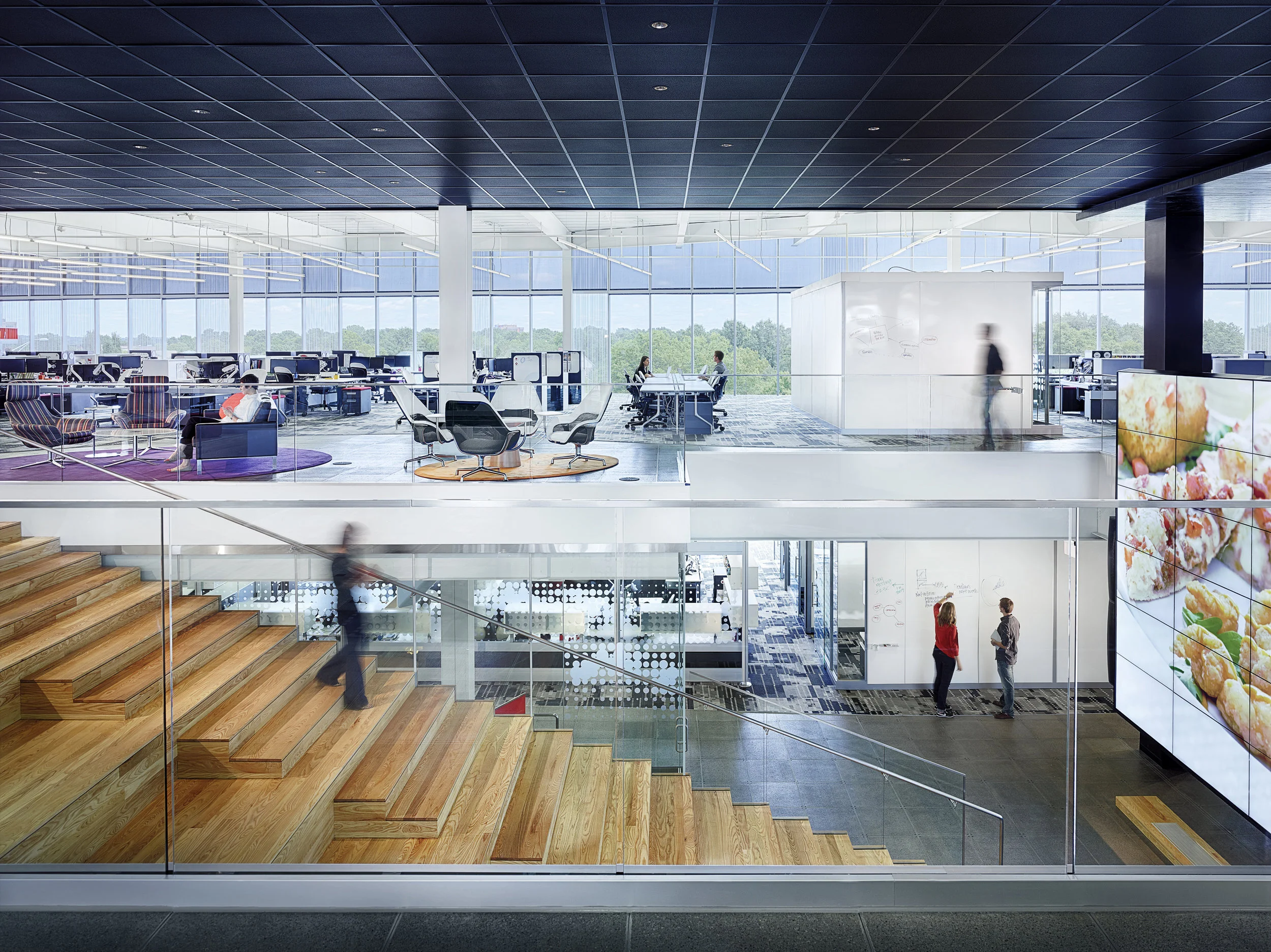
More evidence that younger people are in fact people after all emerges with the publication of a new report from Randstad and Future Workplace. The study of over 4,000 individuals worldwide claims that despite widespread belief, 41 percent of Generation Z employees believe that collaborative, corporate offices combined with a degree of autonomy and flexibility is their preferred way to work. They prefer bosses with strong communication skills, value face to face meetings, are irritated by distractions and believe they will probably have a career focussed oln one specific sector. As a follow-up to a previous study conducted in 2014, the Gen Z & Millennials Collide@Work report focuses on the impact of Gen Z entering the workplace for the first time and how Millennials are engaging with them. Both studies claim that Gen Z and Millennials continue to prefer communicating with co-workers and managers in-person in lieu of email and phone.
The Future of Work: Designing the Workplace of the Distributed Economy
Coming innovations mean that work will be unconstrained by a building, free to expand and evolve, to shrink and transition. Given the evolution of technology, we will continue to work from anywhere and across multiple time zones. In fact, in the next decade, estimates suggest that upwards of 40 percent of the workforce will work remotely or within a distributed work model.
Paradoxically, the new workplace is also about community, social interaction and culture, because as people work more remotely, they encounter new points of interaction. Perhaps people want a place to gather, a place that fosters community brainstorming, and a place that would allow for deeper interpersonal relationships to develop.
DESIGN FOR THE TRANSITION FROM THINKING TO CREATING
Educational institutions and professional organizations are placing more and more emphasis on the role collaboration plays in creating new ideas. They are looking for ways to nurture critical thinking and curiosity by providing environments for authentic, cross-disciplinary connections. This shift couldn’t come at a more prescient time. These types of interactions can lead to increased innovation and engagement – something our global society values more than ever. While heads-down work continues, the changing nature of learning and work has resulted in a shift toward frequent and spontaneous exchanges. Enter the innovation center: a multi-faceted, exploratory setting that supports these goals by allowing people to discover and ideate organically.
From makerspaces to academic incubators to innovation districts, these environments are specifically designed for invention and create the perfect zones for self-directed, project-driven, and multidisciplinary exploration.
Making way for Millennials: How to Design the Workplace of the Future.
The world of boxed cubicles, bosses and 9 – 5 is melting away, and the rhetoric around work is less about work to live and more about live to work. Millennials value their career first, and their ambitions are couched in passionate, creative outlets, whatever the industry. Their parents dreamt of backyards and boats on the weekend, millennials want to feel fulfilled and free Monday through Sunday.
Statistics stating that 40 per cent of the United States workforce will be freelance by 2020 (Forbes) suggest these changes aren’t simply a floating trend, but rather a complete evolution in the way we work. In Australia, the number of independent contractors or self-employed people who did not employ others, as a percentage of the workforce, has already increased from 6.7 per cent in 1978 to 9 per cent in 2013. This statistic is set to accelerate in coming years.
Working from home just as unproductive and frustrating as working in an office
It’s always good to see academic research supporting ideas that would appear pretty obvious but go against a widely accepted narrative. So we should all welcome the results of a new study from researchers at the London School of Economics and Political Science, which found that the perceived benefits of working from home disappear over time for both employees and organisations when homeworking is a full-time arrangement. The report concludes that while previous studies have demonstrated how home workers are more productive than office-based workers, the LSE study of more than 500 employees shows that on a long term basis, there are no differences between home and office workers. The reason, according to Dr Esther Canonico from LSE’s Department of Management, the lead author of the report, is that employees no longer see home working as a discretionary benefit or a privilege when it becomes the norm in an organisation.
We’re only just beginning to understand the issue of indoor air quality
Our aim at BESA is to raise awareness about indoor air quality and encourage more people to be mindful of the best solutions for particular buildings and building types to ultimately promote a healthy workplace environment. The BESA revealed the results of a recent YouGov survey (released on 17 August 2016), which looked into views of office workers and their attitudes toward indoor air pollution in office environments across the UK. The aim of the study was to illustrate attitudes, behaviours and perceptions in order to understand how office workers feel, think and act. Our survey, combined with our ongoing research and collaborations, shows us that opening a window isn’t always the most effective solution to accessing ‘fresh air’ in offices. BESA wholeheartedly agree with Mark Eltringham’s comment that clean, fresh air, is the best way to ventilate a workplace environment. Our survey was commissioned to highlight that in the urban, office environment, this is not always possible.
Who Will Rule the Future of Work? Generalists or Specialists?
When thinking about the future of work, especially in regards to freelance or gig jobs, do you think it is better to be a generalist or a specialist? A generalist is someone who is fairly good at performing a broad range of jobs, whereas a specialist is very skilled in one particular type of work. For example, a handyman vs. an electrician. A handyman can come into your house and work on a large array of problems such as basic plumbing, electrical, or appliance issues. An electrician is only going to be able to come in and fix electrical problems, but he is going to be able to do so with much more expertise than a general handyman. Some people might say it is better to be one or the other, but when looking at the future of work I think it is important to be both a generalist and a specialist.
Your new office is awesome. Here’s how to keep it that way.
Even a new office can underperform.
In a new office, a first office or just a much better version of the old one, too many companies assume the aftermath of a workplace decision is out of their hands.
What happens when you neglect the office—even a new and shiny one? It drifts to places you didn’t anticipate or you find that it doesn’t perform to the level you hoped it would. What’s worse, it’ll be another big project before you come back to this stuff and now you’re stuck with a huge workplace investment that just doesn’t perform.
Nine Steps to Renew Office Culture with an Office Move
So you’ve made the decision to make an office move. It’s an exciting time, filled with opportunities to reinvent, reset and renew. At the same time, the site selection process can be overwhelming. There are several factors at play, including neighborhood, space size, layout potential, availability of sophisticated technology, proximity to amenities, parking and public transportation.
In fact, many of our JLL offices are going through this process ourselves. Just last year, our El Segundo office in the LA area reinvented its space, and right now, our San Diego team will be moving to a new space soon. Each had to determine which of these factors were most important to our employees during the site selection process. For our culture, we knew it was critical to ensure the space could accommodate a variety of collaboration spaces, including conference rooms, lounge areas and cafes.
VIDEO: HUMANSCALE’S HOME OFFICE MAKEOVER: WATCH THE TRANSFORMATION
The winner of our Humanscale UK Home Office Makeover Contest with Grand Designs magazine is now the proud owner of a sleek, stylish and more comfortable place to work.
IT’S TIME FOR A WORKPLACE ATTITUDE ADJUSTMENTIT’S TIME FOR A WORKPLACE ATTITUDE ADJUSTMENT
People are the chief currency and greatest asset of any business. With up to 80 percent of a company’s expenses coming from human resources, it’s vital that their workforce is productive, engaged, and empowered. Unfortunately, 68 percent of U.S. workers are disengaged, according to the latest edition of Gallup’s annual engagement survey. Though there are many factors contributing to this alarming statistic, attitude plays a major role in workplace engagement. And although a well-designed space will have a positive impact on the occupants, we cannot discount or downplay the impact of individual attitudes. In this article, Kay Sargent, senior vice president and director of HOK’s Strategic Accounts practice, looks at how we can create a curated experience, where everyone has the opportunity to be happy, healthy, empowered, and engaged.
Read the article on workdesign.com > [paywall]
One sixth of Australians now work from home mainly to keep up with workload
Almost a third (3.5 million) of all employed people in Australia now regularly work from home in their main job or business, according to figures released by the Australian Bureau of Statistics (ABS). “42 per cent of those who regularly work from home cited catching up on work as the main reason,” said Jennifer Humphrys, Director of Labour Market Analytics at the ABS. “A further 20 per cent regularly worked from home because they wanted an office or didn’t want to pay rent or overheads.” This means in effect that one in six Australians now feel unable to complete their work in normal office hours. These were some of the results from the Characteristics of Employment survey, conducted in August 2015, which collected information on the distribution of weekly earnings, working arrangements and independent contractors. “Nearly one in five employed persons usually worked shift work. Of these, two-fifths usually worked a rotating shift, which periodically changed,” said Ms Humphrys.
What Lewis Carroll can teach us about the office of the future
Lewis Carroll’s second best known work The Hunting of the Snark is a long nonsense poem that describes the pursuit by a group of adventurers of an elusive creature called a Snark. This turns out to be a much more dangerous Boojum when it is finally seen, causing one of the crew members to vanish. The poem may or may not be an allegory for the pursuit of happiness but it could easily be about our pursuit of anything elusive, imaginary or ephemeral. The author never really explains, although the illustrator Henry Holiday believes that the poem is a tragedy, which may back up the original claim. In the parochial world of workplace design and management we can extend the allegory by claiming the Snark as The Office of the Future, the pursuit of which has been ongoing for decades with little success. We’re sometimes shown pictures of it but on closer inspection these always turn out to be hyper-realised versions of The Office of the Present. What we see in them is a Boojum.
Knoll Participates in CoreNet Global ED Forum Workplace Well-being Panel
On August 18, Kylie Roth, Senior Director of Workplace Research at Knoll, presented “Well-being and the War for Talent,” during a panel session at the 2016 CoreNet Global ED Forum in Atlanta. Beginning with a history of the term itself, Roth discussed the growing importance of well-being and employee attraction and retention in the modern workplace alongside panelists Zoe Reich Margarites of Delos Solutions, Felicia Watts of Georgia Power, and Allyson Hajdu of Equifax. Although “wellness” originated in a rhetoric of physical health, she explained, today’s understanding of employee well-being is far more holistic, taking the mental and social aspects of work into account. The panelists continued the discussion by offering their own experiences as case studies for well-being initiatives.
5 ways startups have revolutionized office design
The sun is setting on the American cubicle.
Millennials have already overtaken baby boomers as the largest living generation in the U.S., and they're poised to dominate the workforce — according to a report by Jones Lang LaSalle, millennials will be the dominant demographic by 2020. And as Boomers retire, so too is the outmoded office design that came to define their generation's corporate work environments.
Since the emergence of the modern startup at the turn of the century, tech companies like AOL, Google and Facebook have led the charge in reimagining the rigid formalism of traditional offices in favor of more flexible, human-centered workspaces. As a result, traditional corporations are following suit with ambitious design aimed at fostering work-life balance, retaining the best talent, and inspiring greater productivity.
Only seven percent of workers say they’re most productive working in an office
Fewer interruptions from colleagues, fewer distractions make home the preferred place for maximum productivity, claims a new study from recruitment consultancy FlexJobs. The survey of more than 3,000 respondents interested in work flexibility claims that only 7 percent of workers say the office and traditional work hours form the best time and place for optimum productivity. More than half (51 percent) of people reported that their home is their preferred place to work. Eight percent said they would choose a coffee shop, coworking space, library, or other place besides the office and another eight percent would choose the office but only outside regular hours. 26 percent go to the office during regular hours to complete important work only because it’s not an option to go elsewhere. According to the survey, 65 percent of workers think they would be more productive telecommuting than working in a traditional workplace.
Why Building Better Offices Is The Key To Employee Engagement
Research shows that educated millennial professionals are moving into more densely populated urban environments both for work opportunities and for quality of life. The energy of cities inherently drives innovation. A recent New York Times article describes a trend of large corporate campuses returning to cities to create a new style of workplace and attract younger talent. On a more distributed scale we see the burgeoning of shared work spaces led by WeWork. In both of these trends, the growth of the sharing economy is key. When people live and work in close proximity, it allows for the efficient sharing of cultural, leisure, social and professional amenities.
How wellness is shaping office design
We know that sitting in front of a computer screen all day doesn’t do our health any favours, but recent research published in The Lancet has again highlighted the true cost of a sedentary lifestyle: those who sit for eight hours a day have up to a 60 per cent higher risk of dying prematurely compared with those who exercise for an hour daily. For businesses, the cost of poor health is lower productivity, which is why the issue has found its way into the boardroom and subsequently into the workplace.
But telling employees to exercise at the start or end of their day isn’t a realistic solution. Nudging them in the right direction by providing workplace initiatives and a healthier environment is much more feasible. We’ve seen a rise in employers and landlords promoting wellness within the office itself. This goes far beyond subsidising gym memberships; very often it’s changing the very way the office is designed.
What Does The Future Of Work Mean To You?
Every time conversations about the future of work come up, the focus seems to always be drawn towards jobs and technological unemployment (or employment). Everyone is concerned with the job of the future and if in fact there will be jobs in the future. Naturally this is understandable.
Still, I feel "the future of work" is much broader in scope than just looking at jobs. Behaviors, management style, demographics, and globalization are all rising themes in the future of work, among many others. Communication and collaboration are also a huge area of focus. That being said, I want to know what you think about when you hear the phrase "future of work." What do this phrase actually mean to you? Does this conjure up robots and automation? Perhaps this makes think about workplace flexibility and autonomy? Use #AskTheFuturist on Twitter to share your thoughts. You can also use the hashtag to ask me a question for a future episode. I'm very curious to read your responses!
Fads in corporate architecture: Putting on the glitz
PICTURE a set of Lego that covers 50,000 square metres (540,000 square feet), costs over one billion Danish kroner ($150m), and has a mini-golf course on its roof. In reality the new global headquarters of the Lego Group will be of real bricks and concrete, but its boss, Jorgen Vig Knudstorp, describes it with childlike glee. It will rise up in Billund, in rural Denmark, he says, as “a great facility, not opulent, very playful, for children too.” “People house” will be a totem of the firm’s success.