
Working Life

Focus on Focus (Spaces)

Focus on Focus (Spaces)

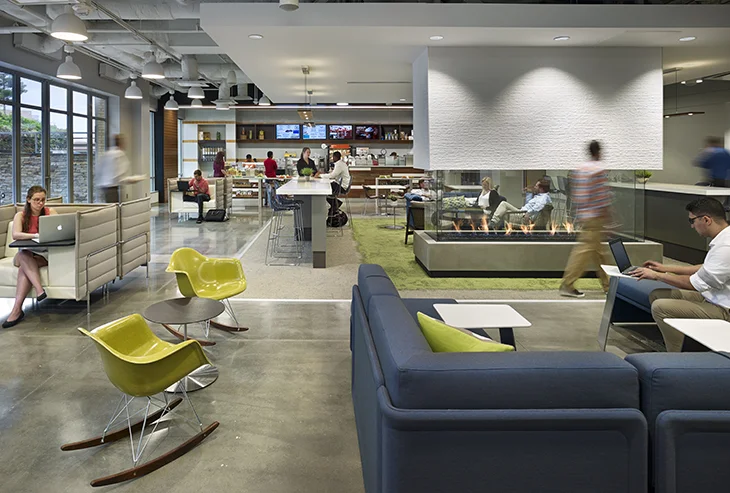
For decades, corporate office layouts have fluctuated between fully open and partially enclosed workspaces. But the latest swing back to fully integrated, collaborative work environments has generated a myriad of complaints about a lack of privacy, both acoustic and psychological. To balance our clients’ needs for real estate efficiency and staff comfort, we aim to design an optimal balance of public and private space for a successful workplace.

Read the blog post on interiorarchitects.com >

THREE STRATEGIES TO INCREASE MOVEMENT BY DESIGN

THREE STRATEGIES TO INCREASE MOVEMENT BY DESIGN

Can design make you healthier? Can you leave work in the evening feeling better than you did when you clocked in that morning? Leigh Stringer thinks so. In this piece, exclusively for our premium subscribers, enjoy an excerpt from Stringer’s new book, The Healthy Workplace. The tips below appear in chapter four, “Maximize Energy, Avoid Crashes”.

Read the article on workdesign.com >  [paywall]

Businesses worldwide ready to welcome robots into workplace

Businesses worldwide ready to welcome robots into workplace

Businesses are ready to embrace the new era of robot workers, automation and artificial intelligence, according to a new report. The Robotic Workforce Research study by AI specialists Genfour claims that more than half of respondents globally are ready to embrace the arrival of robots in the workplace. Almost half of respondents believe that between 10 and 30 percent could be subject to automation. Across all businesses in the UK and US, 94 percent responded that they would either embrace robots or felt a robotic future would be inevitable. Almost half (46 per cent) of UK businesses say they are set to welcome robots at work. A similar proportion (47 per cent) believe it is inevitable, and a third (32 per cent) believe they’ll be able to automate as much as 20 per cent of their business as soon as the technology becomes available. Just seven per cent are worried robots would steal jobs and 16 per cent currently have not planned automation.

Read the article on workplaceinsight.net > 

THIS COWORKING SPACE IS GIVING OFF MAJOR SUMMER CAMP VIBES

THIS COWORKING SPACE IS GIVING OFF MAJOR SUMMER CAMP VIBES

El Segundo, Calif.-based ad agency Ignited recently designed and developed El Camp, a coworking space that will serve both as the agency’s new home, as well as a “plug and play” workspace for other like-minded marketing companies. The facility is located in a converted aerospace manufacturing plant, with the old-school features to prove it: high ceilings, lots of parking, and expansive indoor and outdoor areas. What’s more, Ignited decided to give the coworking space a “distinct summer camp vibe”, and included everything from picnic table-like workstations to outdoor fireplaces for barbeque and s’mores.

Read the article on workdesign.com >

THESE ARE THE BEST OFFICE COLORS FOR WORKING MORE PRODUCTIVELY

THESE ARE THE BEST OFFICE COLORS FOR WORKING MORE PRODUCTIVELY

Countless books have been written about how to boost your work productivity. But all along, you may have just needed a paint brush.

The environment you work in can have an incredible effect on your energy, creativity and focus — but, let's be real, you don't have time to read a textbook on color psychology. Instead, there's a handy infographic from office supply company Quill that consolidates all the information you need into one handy guide. Now that's productive time management.

Read the article on elledecor.com >

How Your Office Design Can Help Your Team Get More Done

How Your Office Design Can Help Your Team Get More Done

What has no internal walls, height-adjustable desks, floor-to-ceiling whiteboards, the latest in video communications technology - and a great view of Mount Fuji on a clear day?

This is #WhereIWork! When Rakuten headquarters relocated last year to a new building in Setagaya, Tokyo, we did more than change our address. We changed everything about our office and the way we work in it every day. For example, instead of a traditional CEO office, with doors and waiting rooms, my own new workspace just flows into everyone else's. We did away with all of the traditional offices. And to encourage communication and collaboration, there are no internal walls between workstations.

Read the article on inc.com >

Exclusive Survey: The Future of Work in America

Exclusive Survey: The Future of Work in America

It’s 9 a.m. on a Monday morning at the Gigster HQ in San Francisco, but it would be easy to mistake it for late on a Friday afternoon. There are almost no workers around the lofty, cubicle-less office in SoMa, a favorite neighborhood for tech startups. Even the CEO is absent, running a bit late for our interview. But this is not a company built on people showing up at the stroke of a clock so much as checking in whenever they have the time. “There’s always going to be the type of person who wants to work for a bigger company. I think those benefits are great for them,” says CEO Roger Dickey, freshly arrived and describing how his company has attracted hundreds of freelancing developers who craft software on demand. “We’re trying to build the best system for everyone else.”

Read the article on time.com >

Beyond the Five-Foot Grid: Age-Neutral Design in the 21st-Century Workplace

Beyond the Five-Foot Grid: Age-Neutral Design in the 21st-Century Workplace

Metropolis publisher and editor in chief Susan S. Szenasy moderated State of Design: Where We Work, a panel discussion hosted by Meadows Office Interiors in their Manhattan showroom. The panel featured Tom Krizmanic, principal of STUDIOS Architecture; Simon Speak, business development director of Haworth, Inc.; and Gabrielle Rubin Deveaux, senior director of real estate at BuzzFeed. The group discussed the challenges and benefits of creating age-neutral office spaces for today’s employees.

The group acknowledged that some older workers are resistant to drastic changes in the traditional work environment: the key is to try and balance individual concerns with the needs of the business. Said Krizmanic, “You look at the decisions through the lens of what the organization is trying to do so that everybody, from the youngest person to the oldest person, should be on board with that, and then peel off the slight variations that may make the acceptance of the design more palatable.”  

Read the article on metropolismag.com >

Flexwork: A Workplace Strategy for High Performance

Flexwork: A Workplace Strategy for High Performance

Work flexibility isn’t just something we encourage our clients to consider; it’s a workforce and workplace strategy that the change management team at Stegmeier Consulting Group embraces every day.

In fact, as I write this post, today could not be a better example of how flexible work keeps our productivity high, and our work-life balance in check.  Our Cleveland, Ohio-based office is completely empty, and yet, it’s business as usual. “How is this possible?” you may ask.

Read the article on workflexibility.org >

The Outdoor Office is the Latest Innovative Workplace Trend

The Outdoor Office is the Latest Innovative Workplace Trend

Going outside to get some fresh air has always been a great way to reenergize your workday. And these days, you can bring your work outdoors with you.

Outdoor office spaces are the latest trend in a string of innovative and ever-evolving solutions for the changing workforce. The rise of the gig economy means on-demand workers now make up a large portion of the workforce (as of 2015, 53 million Americans worked as freelancers), and new technology is enabling companies to hire remote workers in increasing numbers.

Read the article on blueprint.cbre.com >

Frontline technology, flexibility and food will define London’s future office workspace

Frontline technology, flexibility and food will define London’s future office workspace

Strutt & Parkert launched new research about London’s office employees, which examines how they work and what they want from their office workspace and wider urban environments.  The Office Futures: Workshift survey reveals that occupiers in the coming decade are likely to pursue far more flexible leasing strategies, particularly with regard to their satellite or non-core office space. They will seek to align real estate costs with a volatile business environment, technology that is redefining previously-fixed workspaces and a younger generation, different enough to their forbears, in order to shift long-established working patterns off their axis. 

Read the article on property-magazine.eu >

Beer, amenities to 'bring people together' at new Westchase office building

Beer, amenities to 'bring people together' at new Westchase office building

In a time when there's a surplus of available office space on the market, one of Houston's largest insurance companies inked a prelease with Triten Real Estate Partners for 65 percent of an 187,000-square-foot building in Westchase that broke ground in April.

Kansas City, Missouri-based Lockton Cos., the largest property and casualty insurer in Houston, has leased 120,000 square feet in the eight-story Westchase building underway at 3657 Briarpark, said Scott Arnoldy, president and managing partner of Houston-based Triten Corp.

Read the article on bizjournals.com >

Open-plan office design is preventing workers from concentrating, studies find

Open-plan office design is preventing workers from concentrating, studies find

Lack of private space in office interiors is constraining the creativity and productivity of workers, according to data from two new UK workplace surveys. Gensler's 2016 UK Workplace Survey found that workers were more likely to be innovative if they had access to a range of spaces supporting different working styles, including private, semi-private and open-plan environments.

Read the article on dezeen.com >

The people centric urge to personalise space helps firms to engage employees

The people centric urge to personalise space helps firms to engage employees

In America at least, the great symbol of corporate conformity is the office cubicle. Satirised in the Dilbert cartoons and a staple in any movie about the degrading aspects of modern working life, the cubicle provides a perfect shorthand way of portraying an individual crushed by the corporate jackboot. Yet what these things miss is the propensity of people to personalise their surroundings and claim a space as their own, even if only for the short time they may be there. This seems to be particularly the case when it comes to office design and so we were much taken with this blog which lists the most far out and quirky ways people in the US have found to personalise their cubicles. Of course the need and urge to personalise space are not limited to the US. We often find in the course of our own installations that the first thing people do when they occupy an office for the first time is to personalise their space.

Read the article on workplaceinsight.net > 

How Can the Workplace Impact Innovation?How Can the Workplace Impact Innovation?How Can the Workplace Impact Innovation?

How Can the Workplace Impact Innovation?How Can the Workplace Impact Innovation?How Can the Workplace Impact Innovation?

Gensler’s U.S. Workplace Survey 2016 is the latest in a series that builds on over a decade of workplace research. We started our journey in 2005 by uncovering a link between a better designed work environment and performance. In every subsequent survey, we have tried to peel back the layers of comprehension—to understand why, and how, workplace makes an impact. Through the years, we have uncovered how people work, and we’ve found that effective workplace design links to higher business performance. In our 2013 survey, we discovered that choice drives performance and innovation. That finding really intrigued us and led to this year’s research question—how can the physical workplace environment impact innovation?

Read the article on gensleron.com >

Millennials will quit if their office isn’t smart

Millennials will quit if their office isn’t smart

If your office technologies are not up to today’s standards, millennials are going to dump you. Seriously, almost half (42 per cent) of people in that age group are willing to quit their job for this reason. The revelation was made in the Future Workforce Study, released by Dell and Intel.

Read the article on itproportal.com >

Offices not yet smart enough to support new ways of working

Offices not yet smart enough to support new ways of working

Employees believe their workplace is not making best use of latest technology, but expect this to improve as remote work begins to provide both quality of life and productivity benefits. In the latest Future Workforce Survey conducted by Dell and Intel, nearly half of global employees believe their current workplace is not smart enough, while 42 percent of millennial employees say they are willing to quit their job if technologies are not up to their standard. The research suggest that the addition of collaborative tools and innovations such as internet of things (IoT) and Virtual Reality (VR) will soon become vital to the workplace. According to the poll of nearly 4,000 full-time employees in ten countries, over half (57 percent) believe they will be working in a smart office within the next five years, while 51 percent believe that better technologies will make face-to-face meetings redundant within the next five years.

Read the article on workplaceinsight.net >

Seven reasons why this will not be the office of the future

Seven reasons why this will not be the office of the future

It seems like we don’t have to wait more than a few days at a time before some or other organization is making its own prognosis about how we will be working in the future. The thing these reports usually share in common, other than a standardized variant of a title and a common lexicon of agility, empowerment and connectivity, is a narrow focus based on their key assumptions about what the office of the future will be like. While these are rarely false per se, and often offer valuable insights, they also often exhibit a desire to look at only one part of the great workplace elephant. The more serious reports invariably make excellent points and identify key trends, it has to be said. However, across them there are routine flaws in their thinking that can lead them to make narrow and sometimes incorrect assumptions and so draw similarly flawed conclusions. For this reason, talk of the office of the future tells us a lot about how we view offices right now.

Read the article on workplaceinsight.net >

Tech Companies Are Booming And Fueling Your Commercial Real Estate Market. BUT!

Tech Companies Are Booming And Fueling Your Commercial Real Estate Market. BUT!

VIDEO: No laughing matter: Workplace crimes against productivity

VIDEO: No laughing matter: Workplace crimes against productivity

Too hot. Too cold. Too loud. Too hard to find a meeting room. These “crimes against productivity” are all too common.

Despite the large body of evidence correlating office environments with employee effectiveness, today’s workplaces still struggle. Decades of workplace research has shown that seemingly minor office issues— from depressing lighting and stuffy air to noise and a lack of outdoor views—makes employees not just less healthy and happy, but also less productive.