
Working Life

Why Managers And Staff Have Very Different Ideas About Open Offices

Why Managers And Staff Have Very Different Ideas About Open Offices

What makes an office worker happier than perks like free food, natural light, or even onsite day care? According to a new report by Oxford Economics and consumer electronics company Plantronics, one of the most important "perks" is the ability to focus.

The majority (68%) of the 1,200 employees and managers surveyed placed a distraction-free environment in their top three priorities for their workplace. There’s just one thing standing in the way of that ideal: the open office.

Read the article on fastcompany.com >

Taking 'healthy design' from movement to reality

Taking 'healthy design' from movement to reality

When it comes to using design to improve public health, Little Diversified Architectural Consulting and Boeman Design couldn’t be more similar. Little, a mid-sized architectural firm, and Boeman Design, a husband-wife team in Chicago, are both using healthy building design as a market differentiator. Both have clients interested in healthy building design as a way to increase employee productivity, recruitment, and retention. And both work on projects that feature new design techniques as catalysts for improving the health of people all over the world.

Read the article on new.aia.org >

Why the Conventional Wisdom About Job-Hopping Millennials Is Wrong

Why the Conventional Wisdom About Job-Hopping Millennials Is Wrong

Millennials are frequently derided as job-hopping slackers who prefer “gigs” to careers and don’t think about job security because they are happy moving from company to company. Based on hundreds of interviews colleagues and I have conducted with millennials, we’ve concluded that many of them want job security a lot more than people think they do. They saw the devastating effects of layoffs on people’s lives during the Great Recession and its aftermath, and are concerned about finding themselves in a similar situation. They want the chance to put down roots, to buy homes or cars or have long-term leases, to save for retirement, to plan ahead for the next few years, not just the next season. But many don’t think they can make those financial or personal commitments because they don’t believe they have job security.

Read the blog on blogs.wsj.com >

Robots on Track to Bump Humans From Call-Center Jobs

Robots on Track to Bump Humans From Call-Center Jobs

Robots already are starting to displace some humans from low-end tasks such as monitoring the performance of digital networks, according to Benedict Hernandez, an executive at the IT and Business Process Association of the Philippines, the industry trade group. And, while robots aren’t yet smart enough to replace the human phone operators who do jobs like fielding calls from bank clients or helping people reset their modems, they will be within five years or so, according to Mr. Hernandez and other outsourcing specialists.

Read the article on wsj.com >

10 Design Ideas For The Perk Workers Actually Want: Quiet

10 Design Ideas For The Perk Workers Actually Want: Quiet

Do expensive amenities like great food and game rooms really attract the best employees? That's been the conventional wisdom for the past decade. But more and more offices are rethinking what the most meaningful perks are—doing away with cafeterias for more vacation time, for example. While some argue that unlocking engagement from millennial workers lies in playground-like offices, CityLab highlights a new survey that says that it's peace and quiet that's the real key. Carried out by Oxford Economics (a spin-off organization of Oxford University), the results revealed that uninterrupted work time was at the top of most of the 1,200 respondents' wish lists. Meanwhile, none said that free food was the most important.

Read the article on fastcodesign.com >

Is tech addiction making us far more stressed at work?

Is tech addiction making us far more stressed at work?

We are the distracted generations, wasting hours a day checking irrelevant emails and intrusive social media accounts. And this "always on" culture - exacerbated by the smartphone - is actually making us more stressed and less productive, according to some reports.

"Something like 40% of people wake up, and the first thing they do is check their email," says Professor Sir Cary Cooper of Manchester Business School, who has studied e-mail and workplace stress.

Read the article on bbc.com >

Younger and older workers share many of the same attitudes to the workplace

Younger and older workers share many of the same attitudes to the workplace

The behaviour and attitudes of young people in the workplace are very similar to those of older generations. We keep repeating this point but it’s always worth reminding ourselves given the prevailing narratives that obscure this truth. Indeed, so powerful is the narrative that even when a piece of research or a survey contradicts it, there is often an attempt to ignore the report’s own finding’s in favour of something that fits the meme. This happens more often than you think which is why it’s always worth going beyond the headlines to look at what lies beneath. This week, two reports have appeared which highlight just how much a younger generation of workers shares the same attitudes and challenges as other generations. According to the reports, this is true for issues such as presenteeism and the need for the company of colleagues and so suggest we don’t need to treat different age groups quite so differently as is often claimed.

Read the article on workplaceinsight.net >

US small business owners still cling to ‘office basics’, claims study

US small business owners still cling to ‘office basics’, claims study

Small businesses still rely heavily on the traditional working environment, according to the 2016 Business Survey from office equipment maker Brother. The report says these businesses are open to adopting next-generation cloud based and mobile technology, but they’re also ‘holding on to’ what it calls office basics such as printers, scanners and faxes.

Read the article on workplaceinsight.net >

This Google-inspired office design a game-changer for anyone who sits at a desk all day

This Google-inspired office design a game-changer for anyone who sits at a desk all day

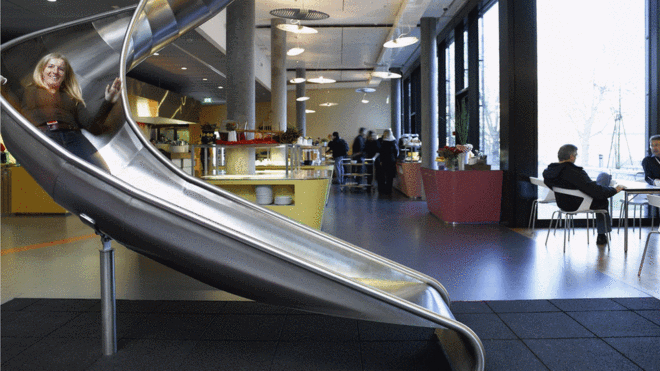
Far more than the standard compilation of desks and computers, the Sugar Land headquarters of Heavy Construction Systems Specialists (HCSS) is a game-changer in office design with unique amenities ranging from an adult slide to a climbing cargo net.

Read the article on houston.culturemap.com >

What Is The Role Of A Workplace After A Tragedy?

What Is The Role Of A Workplace After A Tragedy?

It’s a safe bet that Monday-morning watercooler talk included shock and disbelief over the tragedy that took place in the Orlando nightclub Pulse. Unfortunately the topic isn’t new, as shootings have become more common. And while employees will talk, when should workplace leadership enter the conversation?

Read the article on fastcompany.com >

Designing for the Modern Office Environment Is a Subtle Science

Designing for the Modern Office Environment Is a Subtle Science

Our latest Design Challenge focuses on creating task-related furniture for freelancers in an ever-evolving and highly amorphous work landscape, an issue that is becoming even more relevant as freelancers begin adding up to more than a third of the workforce in the United States today. Who better to ask about how office environments and the nature of work has changed than designers working for a company specializing in this area for over 30 years?

Read the article on core77.com >

Poor office acoustics is biggest issue for workers, but bosses aren’t listening

Poor office acoustics is biggest issue for workers, but bosses aren’t listening

Open-plan offices are meant to encourage collaboration and contribute to a collegial workplace culture, but they also come with serious drawbacks like noise and distraction. New research claims that more than half of employees said poor office acoustics reduces their satisfaction at work. Many feel compelled to solve the problem on their own, blocking out distraction through visits to break out spaces, taking walks outside, or listening to white noise and music on headsets or headphones. The survey of more than 600 executives and 600 employees by Oxford Economics and Plantronics set out to understand what works for employees—and what doesn’t—about open-plan layouts, and to test for disconnects between workers and their managers. The results show that threats to productivity and worker peace of mind are bigger issues than most executives realise, and most do not have the technology or strategies in place to deal with the problems.

Read the article on workplaceinsight.net >

Homeworking loses appeal as workers prefer flexible office environment

Homeworking loses appeal as workers prefer flexible office environment

Most workers now look for flexibility in where and how they work finds a new survey from the British Council for Offices. But this doesn’t mean homeworking; as less than a third (28 percent) of workers now say they would prefer to work from home, a figure that has dropped from 45 percent in 2013, when the research from the BCO and Savills was last conducted. Over three-quarters of respondents (77 percent) said that they currently work in a traditional office, with the majority (60 percent) choosing to work from a dedicated workstation compared to only four percent that are asked to share desks with colleagues. This desire for a dedicated desk has increased over the past three years, rising from a figure of 41 percent in 2013; but despite demand for a dedicated desk, most workplaces (70 percent) now also include a communal environment to work from, providing a space for more dynamic working.

Read the article on workplaceinsight.net >

Breaking the Chains: The Google Guide to Spatial Freedom at Work

Breaking the Chains: The Google Guide to Spatial Freedom at Work

It’s no surprise that the phrase “chained to your desk” has negative connotations. The notion that one must stay put to get work done is deeply rooted in our society, but deeper than that lies the reason for its associations of dread: People don’t like to sit still. From jail cells to frozen passports, restrictions on movement have been employed as punishment for ages. So why, then, would any business owner who truly values their employees insist they work only in one spot throughout the day? While support for this arrangement may cite the dependability of consistent placement as an advantage, the perceived value of this practice is slowly changing as the world quickly becomes increasingly digital.

Read the blog post on architizer.com >

Managing the High-Intensity Workplace

Managing the High-Intensity Workplace

People today are under intense pressure to be “ideal workers”—totally committed to their jobs and always on call. But after interviewing hundreds of professionals in many fields, the authors have concluded that selfless dedication to work is often unnecessary and harmful. It has dysfunctional consequences not only for individuals but also for their organizations.

Read the article on hbr.org >

Six-hour days make workers happier and more productive, study finds

Six-hour days make workers happier and more productive, study finds

Employees are more productive and have better health if they work a six-hour day, an experiment in Sweden has found. Staff at the Svartedalens nursing home in Gothenburg took part in a controlled trial of a 30-hour working week, with an audit published on the experiment in April finding staff were more productive and energetic – with patients at the home reporting an improvement in their care.

Read the article on independent.com.uk >

AFTERSHOCK: HOW DESIGN MITIGATES ENVIRONMENTAL STRESSORS

AFTERSHOCK: HOW DESIGN MITIGATES ENVIRONMENTAL STRESSORS

When we talk about designing for climate adaptation, we first and foremost concern ourselves with the preservation and protection of human life.  While the understood goal of resilient buildings is to physically protect both the property and the people, resiliency can also have positive mental health effects for building occupants. Knowing that increased stress levels have been found to directly cause greater psychological issues including suicide, domestic abuse, and other destructive behaviors, my colleague, David Cordell, and I set out to explore how the interior environment could actually reduce mental distress.

Read the blog post on blog.perkinswill.com >

Why the future office will be as much about fun as work

Why the future office will be as much about fun as work

Technological advances mean that staff can avoid the drudgery of commuting and work from home, coffee shops, or any number of exotic locations. So some companies are working extra-hard to make their offices more attractive places to be.

Read the article on bbc.com >

Democracy is a great thing, except in the workplace

 Democracy is a great thing, except in the workplace

CEOs must listen very carefully to their employees but they have to do what is best for the company, employees, and shareholders. They have to make tough decisions and take responsibility when things go wrong. They expect that once the decision is made, everyone will comply — whether the decision was good or bad. The best leaders share the credit when they achieve success and take all the blame when things go wrong.

Read the article on washingtonpost.com >