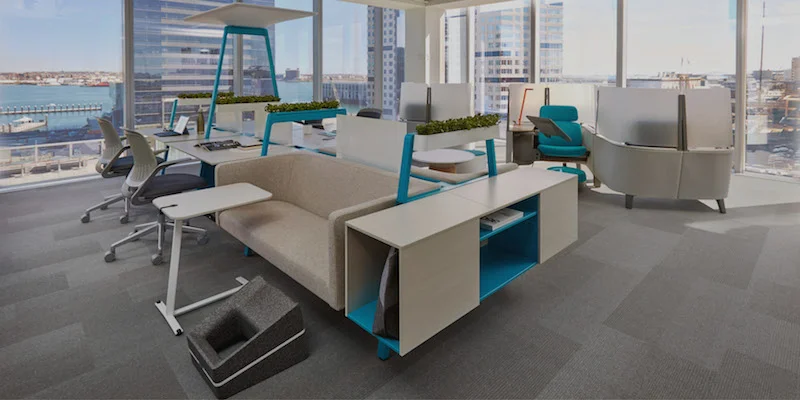


Most employees now have access to mobile devices in the workplace and this ability to work anytime anywhere means that 49 percent of respondents in a new global study by the Economist Intelligent Unit (EIU) say mobile working has the greatest impact on productivity, while for 38 percent it determines how satisfied they are with their employer. The study, sponsored by Aruba, claims that companies rated by employees as ‘pioneers’ in how they support mobile technology saw a rise in productivity (16 percent), creativity (18 percent), satisfaction (23 percent), and loyalty (21 percent) when compared to organizations that were poorly rated at supporting mobile tech. While a respondent’s age was not found to be a factor of how mobile technology impacts their performance and engagement, four out of ten Millennials did admit they would never work for a company that didn’t allow them to use their own devices for work, compared to 22 percent of all employees.
Can Workplace Wellness Help the Environment?
Healthcare in America is some of the best you can receive in the world, but the healthcare system is not without its costs. One such cost that has begun to receive added attention in recent years is the environmental footprint of the estimated 5,000 hospitals in the United States. According to the Journal of the American Medical Association, these facilities produce huge volumes of waste (as much as 7,000 tons per day), and account for 8% of America’s carbon emissions.
How to Design an Open Office Introverts Will Love
Everyone gets excited when the time for a new office rolls around. Standing desks! Natural light! New kitchen! But tough luck if you're an introvert. Chances are any semblance of privacy will be kicked to the curb. Despite evidence that open offices decrease productivity, create time-consuming distractions, and are more costly than private offices, 70 percent of offices now have an open floor plan.
How Telecommuting is Shaping the Modern Office
Telecommuting is on the rise. And with more and more work done online, it’s hardly surprising. Who wouldn’t want to skip the morning commute and work from the comfort of home? But not everybody is happy about the shift—especially office landlords, who are adapting to the trend by rethinking office layouts and searching for the best ways to stay competitive while giving modern tenants what they're looking for.
5 Ways to Create a More Productive Workspace
Ever notice your members restless and distracted after lunch or early in the afternoon? Does your community manager notice mindless typing, distracted members, many getting up and sitting down and then getting up again? Though many a time internal factors such as lack of sleep or overeating lead to this kind of behavior, truth is that environmental factors also contribute to them. Which is why it’s important for your workspace to be inviting and encouraging. Think of it this way: when you’re in a room that’s too hot or too cold, that is noisy, and has bright colors you can’t sleep well – you don’t feel rested. Well, same goes for the workspace; the same factors in a room that can influence or deter sleep can also drive or deter productivity.
How to Make Work Healthier: Move It!
How sedentary is your work? If you’re like many office workers, you probably wish you could be more active, maybe spend less time sitting. But, work keeps most of us at our desks. We may have a cell phone, maybe a tablet or laptop, so you’d think we could be fairly mobile. But most workers aren’t.
Why Your Office Space Matters More for Productivity Than You Think
What's the relationship between quality of office space and company performance in tech companies? originally appeared on Quora - the knowledge sharing network where compelling questions are answered by people with unique insights.
Gen Y's Number One Most Basic Need In The Workplace
When asked what millennials need in the workplace, I struggle to answer concisely. Because it’s many things. It’s competency; it’s mentorship; it’s flexibility; it’s training; it’s clearly-outlined objectives; it’s independence. I didn’t realize that these desires had an overarching theme until I studied attachment theory, which suggests that our relationship styles are formed in childhood with enduring, pervasive consequences.
How to Design an Office to boost Productivity + Wellbeing
Workplaces communicate with people. Not to worry. Big Brother isn’t implanting Siri into your office furniture. But the office environment you’ve designed sends a message to the people that work for you.
“Workplaces where employees are engaged communicate to the people who work there — and anyone else in them — that their employer values them and the contribution that they make.” writes Sally Augustin, Ph.D. in the Harvard Business Review. “The psychological lift that comes from feeling respected enhances engagement.” Augustin is a practicing environmental psychologist and principal at Design With Science.
Is Your Job Making You Fat?
How much did you weigh when you started your current job? And what do you weigh now? Forgive the personal questions but, if you’re anything like the 3,000 full-time employees in a new CareerBuilder survey, you’ve noticed that you’ve put on at least a few pounds—and you’re not thrilled about it.
HOW SHEFFIELD HALLAM TURNED ITS OFFICE INTO A HIGH-PERFORMING WORKPLACE
A generational change in technology, working culture and staff demands are continuing to drive a significant impact on the development of workspaces, and has forced managers of even the biggest corporations to adapt their office layout to get the best out of their workers. No longer are the dull deary isolated cubicles enough for employees.
Flexible Workspaces Improve Urbanism
Much has been said about flexible workspaces as it relates to work-style, but little has been said about them in regards to how they help improve a city or neighborhood. Flexible workspaces are all about providing workers with an option and a solution that adapts to their working needs. This goes from offering different rates and packages (hourly, daily, weekly, monthly, yearly), to also offering them with the option of where local business owners and local entrepreneurs want to work from.
Flexible Workspace Industry Research
As an industry, flexible workspace is an opportunity-rich hybrid that can – and frequently does – branch out into many new and exciting avenues. But words alone don’t do justice to the strength and vitality of the flexible workspace sector. We need statistics to give us a clear indication of how and where the industry is developing, its strengths and weaknesses, the challenges that lay ahead, and its ultimate potential.
Ideo: The 7 Most Important Hires For Creating A Culture Of Innovation
We all fear the job that looks great on paper and is a nightmare in practice. What makes some companies great to work for and others a disaster? The answer: good workplace culture. It’s the difference between Google and Yahoo, Costco, and the Department of Corrections. Studies have shown that office culture is one of the most revealing indicators of workplace satisfaction. How can companies be intentional about building and nurturing a good workplace culture?
How can commuting to your choice of office affect staff productivity?
To say that I am obsessive about the subject of productivity in the workplace is an understatement. It is integral to much of the subject matter I write about, including the core theme contained in my book Don’t Worry About The Rent. Whilst undertaking research, it was important for me to get to the bottom of the decision making processes that many businesses go through when choosing office space. I was well aware of the predisposition for the commercial real estate industry to ask questions around size, cost and location, but I was particularly interested in what other issues might rise to the surface and become “top of mind” for management to consider around office choice. Predictably, I found that tenant surveys, including those undertaken by Colliers International confirmed that the two major issues management would consider were size and cost. The next biggest issue however was a surprise and it related to concerns around commuting.
Employers’ and workers’ views on an engaging workplace differ widely
Business growth is radically redefining how employees are managed, especially as there is greater competition than ever to hire the best people from a much more demanding employee population. Yet employees report that a lack of development, outdated processes, and discontent with the role of their managers are causing them to feel dissatisfied according to Mercer’s 2016 Global Talent Trends Study, the first to take into account the perspective of both employers and employees. While 85 percent of organizations admit that their talent management programs need an overhaul, 70 percent are confident about filling critical roles with internal candidates, 28 percent of employees say they plan to leave in the next 12 months even though they are satisfied with their current role. Managing these challenges requires support but only 4 percent of HR professionals feel that the HR function is viewed as a strategic business partner within their organizations.
When you have to make a choice – who gets an adjustable worksurface?
Sit-to-stand worksurfaces are popular; spending money is not. When budgets are tight, some companies create protocols to determine which employees receive a dedicated height-adjustable worksurface. In the interest of providing a benchmark, I would like to outline the strategies that I have seen, and provide an ergonomist's perspective.
Why Are America's Most Innovative Companies Still Stuck in 1950s Suburbia?
When Apple finishes its new $5 billion headquarters in Cupertino, California, the technorati will ooh and ahh over its otherworldly architecture, patting themselves on the back for yet another example of “innovation.” Countless employees, tech bloggers, and design fanatics are already lauding the “futuristic” building and its many “groundbreaking” features. But few are aware that Apple’s monumental project is already outdated, mimicking a half-century of stagnant suburban corporate campuses that isolated themselves—by design—from the communities their products were supposed to impact.
The new corporate workplace: Beers on tap, bring your dog to work and a short-term lease
When co-working firm Cross Campus opens an office in downtown Los Angeles next month, its tenants will include the typical start-ups looking for collaborative work environments, shared coffee bars and the flexibility of a short-term lease. But the 33,000-square-foot location on Wilshire Boulevard also will house businesses of a less typical variety, including real estate developers, legal firms and FactSet Research Systems Inc., a publicly traded financial data company out of Connecticut with more than 8,000 employees worldwide.
On Collaboration: An Interview with Blitz Architecture Principal Melissa Hanley
In the 8 years since Office Snapshots began publishing, we’ve watched the idea of the collaborative office rise to the level of an almost meaningless buzzword. But collaboration – working together to achieve a goal or complete a task – is an essential ingredient in any workplace that will not disappear any time soon. We recently spoke with Melissa Hanley, Principal of Blitz Architecture + Interiors, the San Francisco-based firm responsible for the design of offices for companies like Microsoft, Malwarebytes, Instacart, and Zendesk. She tells us about what collaboration in the contemporary office landscape looks like and how the firm works to help clients create an environment which matches the unique needs of each organization.