


Here’s a radical idea for Canadian companies: Create democracy in your workplace. I don’t mean introducing a voting system – I mean having open dialogue, and getting more meaningful input from employees.
Contract furnishings provider, Hightower received multiple awards at NeoCon 2021, including IIDA's 'Best Small Showroom' (under 4,000 sf) and 'Best of Competition' for its newly designed Chicago showroom.
Humanscale welcomes Elizabeth Margles to its Marketing Division in the role of Chief Marketing Officer. Margles comes to Humanscale with twenty years of experience in design, fashion and retail and a background in public relations and advertising.
The exclusive relationship with Kontrol's BioCloud® Technology will provide real-time detection of airborne pathogens such as SARS-CoV-2 to help make workplaces safer as organizations return to the office.
Here’s a radical idea for Canadian companies: Create democracy in your workplace. I don’t mean introducing a voting system – I mean having open dialogue, and getting more meaningful input from employees.
Billionaire Richard Branson thinks outside the corporate office.
"There are five main places I have worked day-in, day-out over the years, and you will notice that an office is nowhere to be seen on the list," writes Richard Branson in a recent Virgin blog post. "I've never had a proper desk, never worked out of an office, and certainly never clocked in."
When it comes to workplace, small companies and big ones have more in common than you think. I’ve spoken with 20 person startups who are asking themselves the same questions: What does the future work space need to look like to best engage employees?”
As the speed of business accelerates, companies are investing heavily in innovation in an effort to keep up. Creating a culture of innovation, particularly in large companies, isn’t easy though. Here are four common workplace pitfalls that stifle innovation inside companies.
Technology has upended where we work. The line between work and play has been blurred, and the difference between the office and home has all but disappeared.
As a result, there’s a new class of white-collar workers (or no collar, to be precise) who roam the earth looking for places to get their jobs done.
Some of them work from home, curled up on the couch or in a home office — maybe with a drone hovering nearby. Others camp out at expensive cafes, refilling their mugs of fancy coffee throughout the day. (Yes, I’m referring to myself.)
In today’s complex and collaborative workplace, the real challenge is to manage not just your personal workload but the collective one, says Jordan Cohen, a productivity expert and the Senior Director of Organizational Effectiveness, Learning & Development at Weight Watchers. “Helping your team manage its time well is a critical factor for its success.” Elizabeth Grace Saunders, author of How to Invest Your Time Like Money and the founder ofReal Life E Time Coaching & Training, agrees. As a manager, your role is to both “set the strategic vision” and serve as “the buffer for unreasonable expectations” from the rest of the organization. Here are some tips to ensure that your team works productively.
It seems unfair to brand Millennials difficult, when you consider they are the less experienced generation of workers, but new research suggests they require more hand holding in the workplace. When asked about workers they’ve dealt with, 48 percent of bosses felt that millennials were more reliant on detailed targets and required regular progress meetings in order to stay motivated. However, the majority of bosses (89 percent) agreed that these demands indicated that millennials were highly career driven. Over one third (39 percent) named generation X as the most self-sufficient, as this group required less guidance, with Baby Boomers a close second (34 percent). Millennials were also cited as the generation most incentivised by reward and praise (41 percent), followed by Generation X (26 percent), Baby Boomers (22 percent) and Generation Z (11 percent), while Generation X had the biggest desire for a work life balance (37 percent).
In her new book "The Happiness Track," Emma Seppala debunks one of the biggest myths among Western workers: the idea that you have to be insanely stressed to be successful.
While economists, entrepreneurs and policymakers huddled in Davos, Switzerland, last week to discuss the "fourth industrial revolution" and its impact on the global workforce, almost one in three American workers got up in the morning and faced their boss — in the bathroom mirror.
The utopian workplace is here, complete with roof gardens, therapists and time to nap. Can the employee ever escape?
How do you handle working alongside a noisy neighbor in the office? What are the best chairs for a call center? How can a worker get the most from her time on a commuter train?
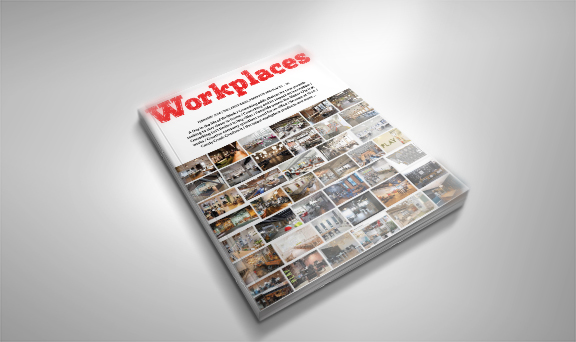
Work is much more than sitting at a desk or tapping away at a computer. Yes, the office remains the hub of what we call work, but it also happens at home, on the subway or airplane, in a far-flung hotel room or a nearby coffee shop. And work is being shaped by products that make the worker more efficient, comfortable, happy and connected. Workplaces Magazine follows everything that makes work happen, from the latest ergonomic office chair to the hottest mobile phone. Yet it is about much more than products. Workplaces Magazine also follows the latest trends about healthy workplaces and new workstyles.
The first issue of the new monthly magazine Workplaces is available for free.
The modern office is nothing like it used to be 10 years ago. Due to advances in technology, work has become more flexible and fluid, and the ways employees and supervisors communicate is a lot more mobile thanks to social media and various communication oriented apps.
The last few years, we’ve seen how many more workers aren’t required to come in to the office anymore, and how those that do make use of flexible workspaces are a far cry from the mundane cubicles of yesteryear.
The Open Office. Crowdfunding. Live-Work-Play. At SeedFeed we believe all of these CRE buzzwords have one thing in common. They exist because of the millennial generation. Now the dominant demographic in the U.S. workforce, this group, born roughly between 1980 and 2000, outnumbers the baby boomers. Their priorities have become the priorities of business, and this has had a profound impact on commercial real estate in the past year.
As the workplace moves from the traditional 9-5 model, management needs to adapt accordingly. Facilities managers are already being forced to think outside the box, and now human resources and line managers must do the same. The latest CIPD/Workday HR Outlook leaders’ survey spells out the challenge; that new ways of working and operating is an increasing reality for organisations. Yet while there is general agreement about overall strategic priorities it seems to be less clear to the wider business world how HR professionals will contribute to achieving these. Despite nearly three-quarters (72 percent) of HR leaders saying that their current people strategy will help the organisation achieve its future priorities, just a quarter (26 percent) of other business leaders agree. The CIPD recommends that the profession must look at ways in which it can innovate itself in order to stay relevant and more visibly demonstrate its ‘enabling role’ as the workplace evolves.
There's an important aspect to workplace wellness that is particularly important for women. Just about everyone feels stress at their job, but for women, work-related stress is directly connected to the gender-based pressures that are part and parcel of most of our jobs.
Stephanie Douglass, Teknion‘s director of workplace strategy, takes a stand. It’s the end of January, and for those of you who didn’t bother making a resolution for 2016 – or if yours has already failed – I’ve got one to suggest for you: No more millennial bashing.
There are plenty who claim that quirky and impressive office perks are pointless, counterproductive, or the wrong way to motivate people. Be that as it may, many startups—especially in tech—have baked those perks into their work cultures. But if history or probability are any guide, they may not be sustainable for the long haul. You may not think so, but putting your unlimited cereal bar on indefinite hiatus can actually do more damage to your culture than you might think.
So how can you create innovative teams within your own company, teams whose work consistently impacts your products and customers in a positive way? The first step is recognizing that your employees are your best assets, and acknowledging that all team members—from the sales team to the CEO to the IT guys—are key players in your success.
Last week, at a social event for senior bankers, I found myself standing in a circle with six men making small talk. As I looked around the group, I noticed that five were clutching tumblers of sparkling water, while only one had joined me in accepting a flute of cold champagne offered by a waiter in a tailcoat.
By now you’ve surely heard that moving forward, every company will be a software company, and that shift is happening now as companies large and small scramble to transform into digitally-driven organizations. Wherever you turn, businesses are facing tremendous disruptive pressure. What’s interesting is that the theory about how firms should be dealing with this massive change is itself in flux, transforming if you will, as organizations come to grips with the idea that the most basic ways they do business are being called into question.