

Florence Knoll Bassett is truly a visionary. As a pioneer of interior and furniture design and a successful entrepreneur, she is one of the most influential architects and designers of postwar America, yet her mark on Modern design transcends any one of these fields. Her studies at Kingswood and Cranbrook Academy of Art during the 1930s impressed upon her a human-centered design approach; at the Architectural Association in London she originated the now-common interior design practice of “paste-ups”; and her time with Mies van der Rohe in Chicago introduced her to a rationalist design approach.
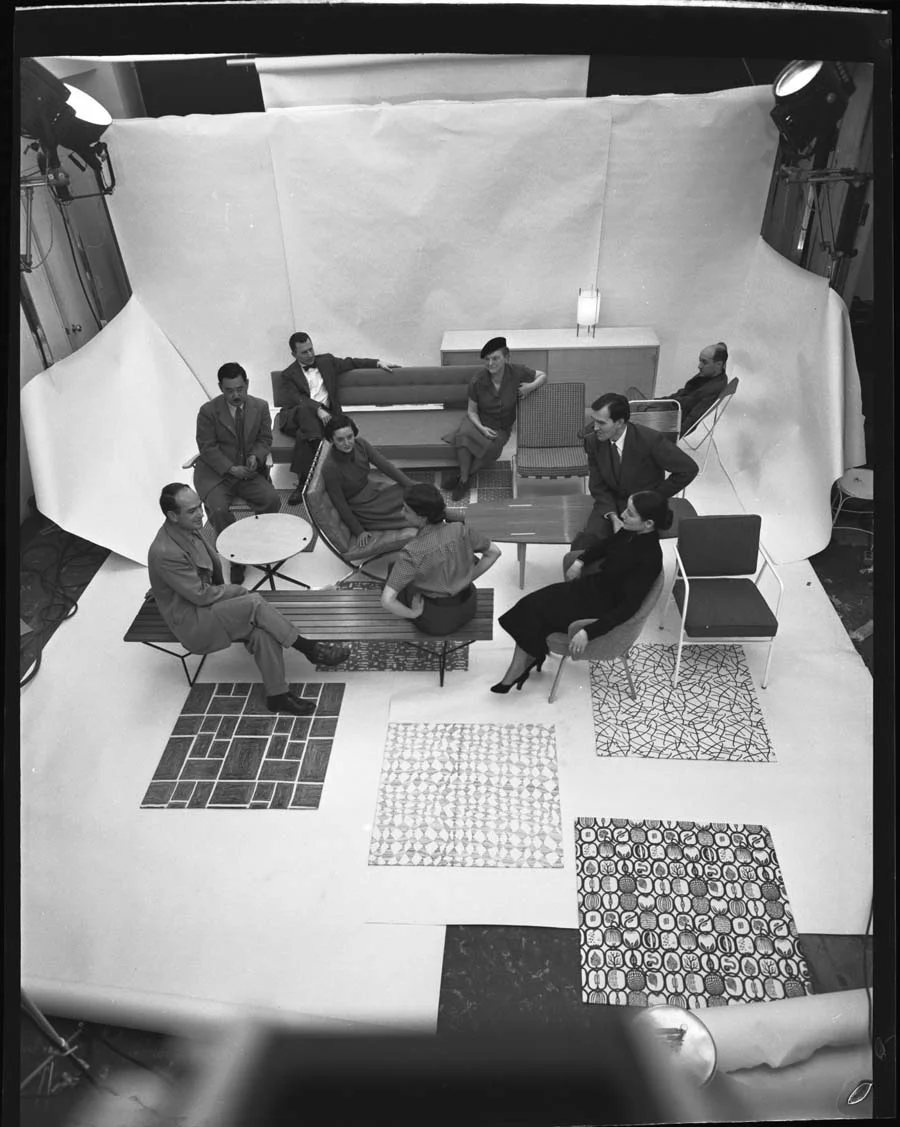
Florence Knoll Bassett surrounded by her stellar collaborators. From left to right: Harry Bertoia, George Nakashima, Richard Stein, Knoll Bassett, Eszter Haraszty, Noémi Raymond, Dorothy Cole, Abel Sorensen, and Isamu Noguchi. Courtesy Tony Vaccaro/Tony Vaccaro Studio
At Knoll, she was the creator and director of the Knoll Planning Unit—focused on its interior division—and was also the design director and critic for the development and production of the company’s furniture, textiles, and graphics. The planning unit was the engine of the firm’s success, and transformed the field of “interior design” from interior decoration to spatial architecture—which in the 1950s was almost completely dominated by men. With designers like Eero Saarinen, Harry Bertoia, and Richard Schultz, she produced furniture classics that are still relevant today.
Knoll Bassett’s ideas were rooted in practical needs, based on rigorous planning, but she developed a signature look while applying design principles to space configuration at corporations. The planning unit’s scope of services, on more than 200 projects in university dorms, corporate headquarters, government offices, and even motels, represented a radical departure from the traditional services offered by interior decorators at the time, and by other textile or furniture showrooms, which focused mainly on selling objects. She looked at the challenge of designing an interior as more than just specifying furniture and fabrics—the stereotypical purview of the interior decorator. “An intelligent interior plan goes further than the furnishings which fill the space,” she said. “It strikes at the root of living requirements and changing habits. Planning involves economics, technical efficiency, comfort, taste, and price.”
At the height of her career, after designing thousands of office interiors, she resigned from Knoll in 1965. She was only 48 years old, but had defined the look for corporate interiors during the 1950s and 1960s, profoundly influenced post–World War II design, raised the level of standards and ethics for interior design as a profession, and promoted the “open office” workspace through a total design approach. Throughout her career, she played the triple role of architect, interior designer, and furniture designer, and she is one of the few who have received the top honors from all the American professional organizations in architecture and design: AIA, ASID, IIDA, and IDSA. In 2002, she was awarded the National Medal of Arts—the highest accolade given to artists by the federal government. With the centennial of her birth this year, we pay tribute to her with some lessons that can be learned from her career and work.